Can a Stainless Steel Lunch Box Go in the Oven?
Published September 17, 2026
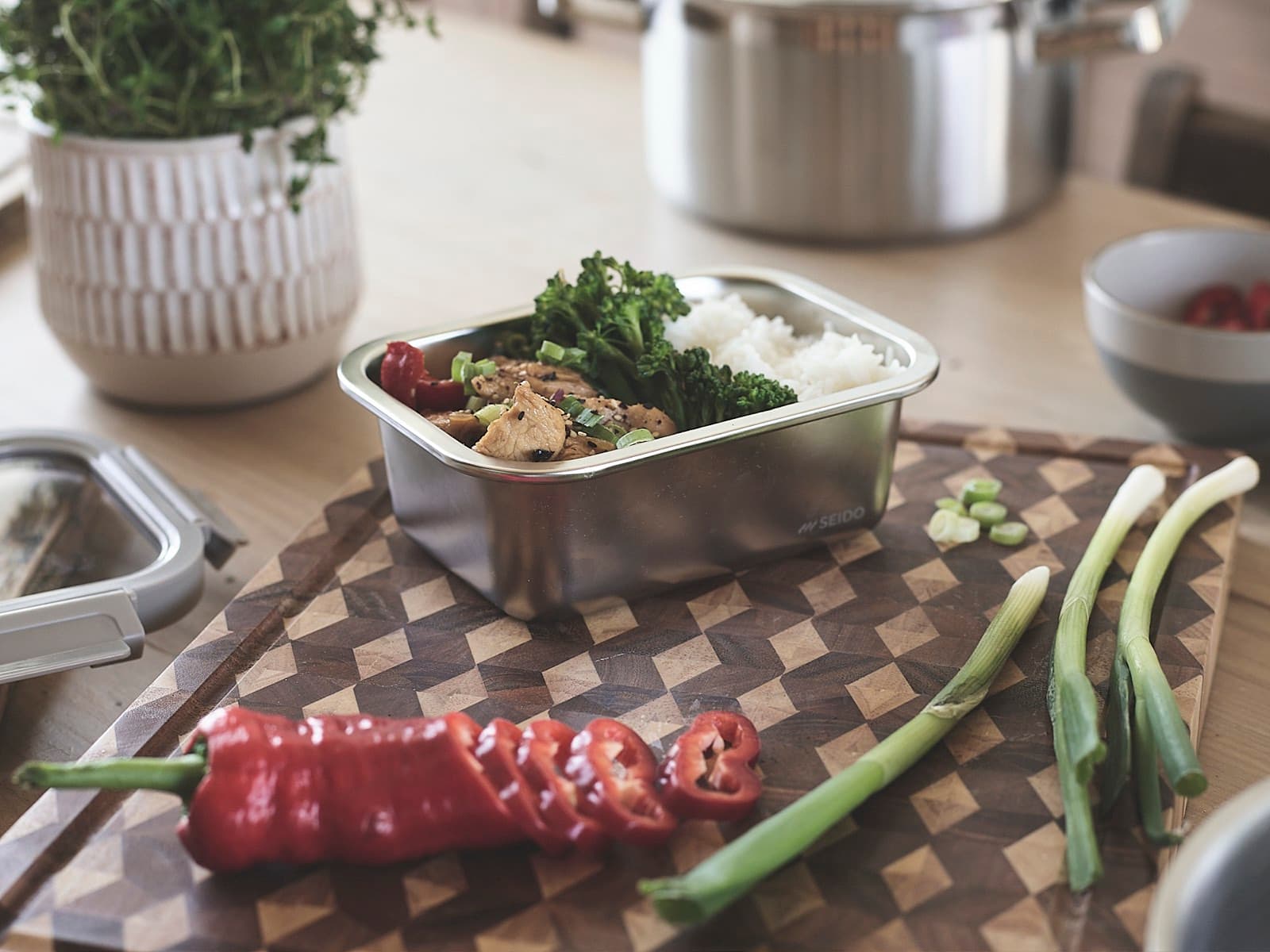
The container often can; the lid can't, and the answer depends on what the maker tested. Our lunch box container is lab-tested at 482°F (250°C) for one hour, container only, tested without its lid; the lid never goes in an oven. Any lid with plastic or a gasket stays out.
Can you put a stainless steel lunch box in the oven?
Stainless steel itself isn't the problem. The metal keeps its strength far above any temperature a home oven reaches for reheating, which usually sits around 325 to 350°F (160 to 180°C). What decides the answer is everything attached to the steel, and whether the maker has actually tested the container in an oven.
Plain, single-wall stainless steel handles ordinary reheating temperatures easily. The parts that fail are the ones that aren't steel: plastic frames, gaskets, painted or coated exteriors, and the sealed air gap inside double-walled insulated containers. Check what your container is made of before it goes anywhere near an oven.
Look at the container in three parts before you use it this way:
If a container is plain single-wall steel and the maker states an oven rating, follow that rating exactly, including what it covers. If the maker says nothing about ovens, assume it hasn't been tested and keep it out.
- The body. Single-wall stainless steel is the only construction to consider. Double-walled insulated containers trap air or a vacuum between two layers of steel, and heating that sealed space is not what they're built for.
- The outside finish. Painted, powder-coated or printed exteriors, and silicone or fabric sleeves, can scorch, blister or give off fumes at oven heat.
- The lid. Almost every lunch box lid includes plastic, silicone or both. Treat the lid as a separate item with its own limits.
Why don't lids with plastic frames and silicone gaskets go in the oven?
A lid is usually the least heat-tolerant part of a lunch box, even when the panel in the middle is glass. The frame that holds the glass, and the clips that hold the lid down, are commonly polypropylene (PP), a plastic chosen because it's tough, light and handles hot food and dishwasher water well.
Oven heat is a different matter. Polypropylene melts at roughly 265 to 340°F (130 to 170°C), depending on the grade, and softens well before that, so a frame can warp or sag at an ordinary reheating temperature. Once a frame has distorted, it no longer holds its shape around the glass or sits properly on the container.
Silicone gaskets vary. Heat ratings depend on the specific silicone compound, and a gasket is only as useful as the frame it sits in. Glass set into a lid frame is made to be a lid, not an oven dish.
The rule is simple and doesn't depend on the brand: if a lid has any plastic in it, it doesn't go in the oven. To keep food from drying out while it reheats, cover the container loosely with aluminum foil instead, and put the lid back on only after the container has cooled.
How do you reheat food from the fridge or freezer in a stainless steel container?
Reheating packed food in the oven is mostly about avoiding sudden, uneven temperature changes and making sure the food gets hot all the way through. The USDA recommends reheating leftovers to 165°F (74°C), checked with a food thermometer in the thickest part of the food.
Uneven heating is the thing to manage. A frozen block of food dropped into a hot oven heats unevenly: scorched at the edges and still cold in the center.
A few habits keep it predictable:
- Thaw first when you can. Thawing in the refrigerator overnight, one of the three safe methods the USDA lists, makes oven reheating far more even.
- Take the lid off before the container goes in, every time.
- Preheat the oven fully first. In many ovens the elements run hard during preheating; a steady oven heats more evenly.
- Use a moderate setting, around 325 to 350°F (160 to 180°C), and cover loosely with foil so the surface doesn't dry out before the middle is hot.
- Stir or break up the food partway through if you can, then check the center reaches 165°F (74°C).
- Allow more time for food that went in cold. A thermometer is the only reliable way to tell when it's ready.
Can a stainless steel lunch box go under the broiler, in a toaster oven or on the stovetop?
An oven rating covers the conditions of the test, and nothing else. Our lunch box container is lab-tested at 482°F (250°C) for one hour, container only, tested without its lid; the lid never goes in an oven. It was not tested under a broiler, in a toaster oven, in an air fryer or on a stovetop, so we make no claim for any of them, and we'd ask you not to use it that way.
A broiler heats with intense radiant energy from an element or flame just above the food, so the surface of the container nearest the heat can get far hotter than the oven's dial setting suggests. Toaster ovens put their elements close to the food in a small space, and their temperature tends to swing more than a full-size oven's. A stovetop burner heats one spot on the base directly and burns food onto it.
If you want a browned or crisp top, move the food onto a baking sheet or an oven dish made for broiling.
Oven or microwave: which is better for reheating in a stainless steel lunch box?
Both can work, and they suit different situations. The oven heats gently from all sides, so it's good for foods that should stay crisp or firm, such as roasted vegetables or a grain bake, and it's the better choice when you're at home with time to spare.
The microwave is faster, which makes it the usual choice at work. Metal behaves differently in a microwave: microwaves reflect off steel rather than passing through it, so food in a metal container heats mainly through its open top. That's why the lid has to come off, and why the container should never go in empty: with no food inside, there's nothing to absorb the energy.
Our lunch box container is lab-tested for the microwave in a 1000 W oven; use it with the lid off, at a maximum of 1000 W, and never empty. Check the wattage label inside the microwave door first. Whichever method you use, stir partway through and check the food reaches 165°F (74°C).
How should you handle and clean a stainless steel container after the oven?
Steel holds and conducts heat, so the container will be as hot as the oven when it comes out. Use dry oven mitts, not a damp towel, because water carries heat straight through fabric to your hands. Set the container on a trivet or a heat-resistant surface, and let it cool before you put the lid back on or pack it away.
Baked-on food lifts more easily after a soak in warm, soapy water. Use a nonabrasive sponge, or a paste of baking soda and water for stubborn spots.
Which stainless steel lunch box has an oven test on record?
If you want a container you can reheat in at home and carry to work, our lunch box 3-pack is built around a plain stainless steel container, 27 oz (800 ml) each, with a glass lid in a PP frame with a silicone gasket. The container is lab-tested for the oven at 482°F (250°C) for one hour, container only, tested without its lid; the lid never goes in an oven. It's also lab-tested in a 1000 W microwave (use it lid off, at no more than 1000 W, and never empty) and for freezer use, and it's dishwasher safe, handwash recommended. See price on Amazon.
Cooking this way is what our stainless steel lunch box 3-pack is built for — 27 oz (800 ml) × 3, microwave-safe, dishwasher safe, 5-year limited warranty.
Frequently asked questions
- Can a stainless steel lunch box go in the oven?
- A plain, single-wall stainless steel container often can, if its maker has tested it for oven use, but a lid with plastic or silicone parts can't. Ours is lab-tested at 482°F (250°C) for one hour, container only, tested without its lid; the lid never goes in an oven. With no oven rating, keep it out.
- Why can't a lunch box lid go in the oven?
- Most lids include a polypropylene (PP) frame, clips or a silicone gasket, and polypropylene softens and can warp at ordinary reheating temperatures. Take the lid off before the container goes in, and cover the food loosely with aluminum foil instead.
- Can I put a stainless steel container straight from the freezer into the oven?
- Thaw it in the refrigerator first if you can; that is one of the three safe thawing methods the USDA lists. A frozen block heats unevenly, scorched at the edges and cold in the center. Use a preheated oven at a moderate setting, cover with foil, and check the food reaches 165°F (74°C), the USDA's reheating temperature.
- Can I use a stainless steel lunch box under the broiler or in a toaster oven?
- We haven't tested ours under a broiler, in a toaster oven, in an air fryer or on a stovetop, so we make no claim for any of them. Broilers and toaster ovens put intense heat close to the container, which is different from the oven test. Move food to a broiler-safe dish instead.
- Are insulated stainless steel food jars oven safe?
- Generally not. Double-walled insulated containers have a sealed air gap or vacuum between two layers of steel, and many have painted or coated exteriors. Neither is designed for oven heat. Follow the maker's instructions, and if there's no oven rating, reheat the food in a separate dish.
Browse all stainless steel lunch boxes or keep reading: Can You Microwave Stainless Steel? · Stainless Steel vs Plastic Food Containers · Stainless Steel Meal Prep Containers for Work and the Gym.