Stainless Steel Meal Prep Containers for Work: What Actually Matters
Published July 31, 2026
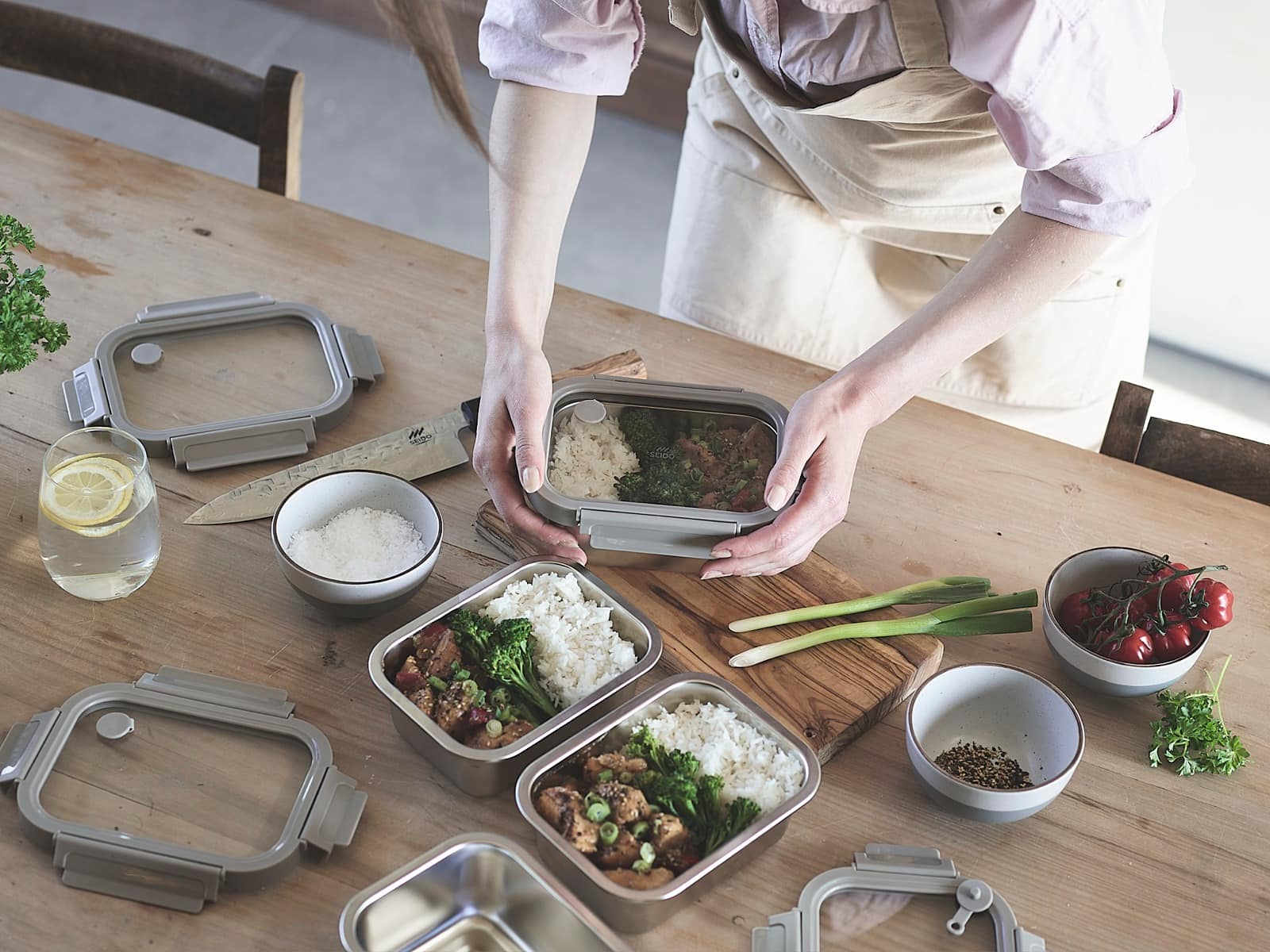
A meal prep container that works for the office or gym needs three things: a portion size that matches a real meal — around 27 oz (800 ml) — a material that resists staining and odors through a week of reuse, and the ability to reheat food in the container itself. Stainless steel that's engineered to be microwave-safe covers all three.
That combination is rarer than it sounds. Stainless steel containers conventionally carry a do-not-microwave warning, and plastic — the familiar microwave-safe default — slowly absorbs pigment and odor with repeated use. A container that does both removes the main friction in weekday meal prep: transferring food to a second dish just to heat it.
What makes a meal prep container work for weekdays?
Weekday meal prep fails at the friction points: the container that's too small for a real meal, the one that smells like last week's curry, the one you can't reheat in. A container that works removes all three. Capacity first — around 27 oz (800 ml) holds an actual adult lunch, not a snack. Material second — the surface has to go through five days of tomato sauce, dressing oil, and spice without keeping a record of them. Reheating third — if lunch has to be transferred to a second dish before it goes in the microwave, the habit dies by February. (Ask us how we know.)
Stainless steel earns its place on the material test. It's non-porous, and the chromium in the alloy forms a thin, self-repairing oxide layer that keeps the surface inert — pigments and oils rinse off instead of soaking in. That's why steel resists staining and odors where plastic slowly absorbs both. Plastic is softer; every fork scratch opens a channel where tomato pigment and grease can lodge, which is why an orange tint and a lingering smell are the usual fate of a plastic meal prep set.
How does the Sunday-batch rhythm work?
The most durable meal prep routine is the simplest one: cook once, portion immediately, grab and go all week. On Sunday afternoon, make one big base — a tray of roasted vegetables and chicken thighs, a pot of chili, a batch of grains and salmon. Portion it into containers while it's still warm, let them cool, then refrigerate. Monday through Wednesday, the morning decision drops to zero: open the fridge, take a container, leave.
Three containers is the natural unit for this rhythm. It covers a Monday-to-Wednesday cycle from a single Sunday cook, and a quick midweek batch — often just refilling the containers you've already washed — carries Thursday and Friday. Portion evenly when you fill them, so Wednesday's lunch is as good as Monday's. And portion straight from the pot rather than storing food in bulk; scooping a cold block of rice into a container on a rushed morning is exactly the step that breaks the habit.
What works best for desk lunches at the office?
The office test is one sentence: can lunch go from bag to microwave to desk in a single container? Every transfer step — decanting onto a plate, hunting for a clean bowl in the shared kitchen — adds friction and dishes. A container you can reheat in directly turns lunch into a two-minute operation: heat, eat, rinse.
Material matters more in an office than anywhere else. A shared kitchen amplifies smells, and a container that carries Monday's salmon into Tuesday makes you that colleague. Stainless steel's odor resistance solves this quietly. It also keeps its looks: steel wipes clean and resists staining, where scratched, clouded plastic reads shabby on a desk. This is the exact case a microwave-safe stainless steel container is built for — the reheat happens in the container itself.
What about a post-workout meal at the gym?
The gym case is a transport problem. The container rides in a duffel, shares space with shoes and a water bottle, and takes knocks. Metal handles this better than brittle plastic, which tends to crack at the corners under repeated impact.
Pack for the commute, not just the meal. Choose food that travels well — rice and chicken, a grain bowl, pasta with a thick sauce — and keep wet elements in check: spoon dressings over just before eating rather than packing a swimming salad, and keep the container upright in the bag. Plenty of post-workout meals eat perfectly well at room temperature; and when the gym lounge or the office you're heading to has a microwave, a microwave-safe steel container means reheating without a plate transfer.
How much food does 27 oz (800 ml) actually hold?
27 oz (800 ml) is just under three and a half cups — one genuine meal. In practice, that looks like:
- A grain bowl: a base of cooked rice or quinoa, a palm-sized portion of protein, and roasted vegetables, closed without compressing
- A dinner-sized pasta portion with a thick sauce
- A salad with substance: greens, a scoop of grains, chicken or chickpeas — dressing packed separately and added at the desk
- A deep serving of chili or stew, with enough headroom that the container closes cleanly
Where does the SEIDO lunch box 3-pack fit?
The honest framing first: one container, one meal. If you eat big, 27 oz (800 ml) holds a dense, calorie-heavy bowl — rice-based dishes pack a lot into the volume. What it isn't is a two-meal vessel; it's sized for one adult and one sitting, which is exactly what a weekday lunch calls for.
Our lunch box 3-pack is built around this exact routine: three stainless steel containers, 27 oz (800 ml) each, microwave-safe by design — an engineered feature, and the reason the office reheat happens in the container rather than on a borrowed plate. The steel surface resists staining and odors through repeated weekly cycles.
Three containers map cleanly onto the week. Run the Sunday-batch cycle — cook once, fill all three, take one each morning — or rotate them as office, gym, and spare. For packing strategies, reheating technique, and more on stainless steel for food storage, the rest of our lunch guides pick up from here.
Cooking this way is what our stainless steel lunch box 3-pack is built for — 27 oz (800 ml) × 3, microwave-safe, dishwasher safe, 5-year limited warranty.
Frequently asked questions
- How many meal prep containers do I need for work?
- Three covers the core cycle: cook on Sunday, portion into three containers, and take one each morning, Monday through Wednesday. A quick midweek batch — usually refilling the containers you've already washed — carries Thursday and Friday. More than three mostly adds cabinet clutter; fewer forces midweek cooking on a schedule that rarely survives a real week.
- Can I reheat food in a stainless steel meal prep container?
- Conventionally no — stainless steel containers have traditionally carried a do-not-microwave warning, the material's long-standing trade-off. SEIDO's lunch boxes are the exception: they're microwave-safe by design, an engineered feature of the container, so the office reheat happens in the container itself.
- How do I stop meal-prep food from going soggy by midweek?
- Sogginess is mostly a moisture-management problem. Pack components rather than fully assembled meals where you can, keep dressings separate and add them at the desk, and place crisp elements on top rather than under wet ones. Let cooked food cool before you close the container so condensation doesn't rain back onto it, and when you reheat grains, a small splash of water restores texture.
- Is stainless steel better than plastic for meal prep containers?
- For repeated weekly use, yes, on mechanism: stainless steel is non-porous and protected by a self-repairing chromium oxide layer, so pigments and oils rinse away — it resists staining and odors. Plastic is softer and slowly absorbs both, especially once utensil scratches give them somewhere to lodge. The traditional catch was reheating, and a stainless steel container engineered to be microwave-safe removes it.
Browse all stainless steel lunch boxes or keep reading: Can You Microwave Stainless Steel? · Stainless Steel vs Plastic Food Containers · How to Read a Cookware Spec Sheet: Grade, Ply, and What a Test Certificate Proves.