
3-Ply vs 5-Ply Stainless Steel: What Actually Matters
Published August 28, 2026
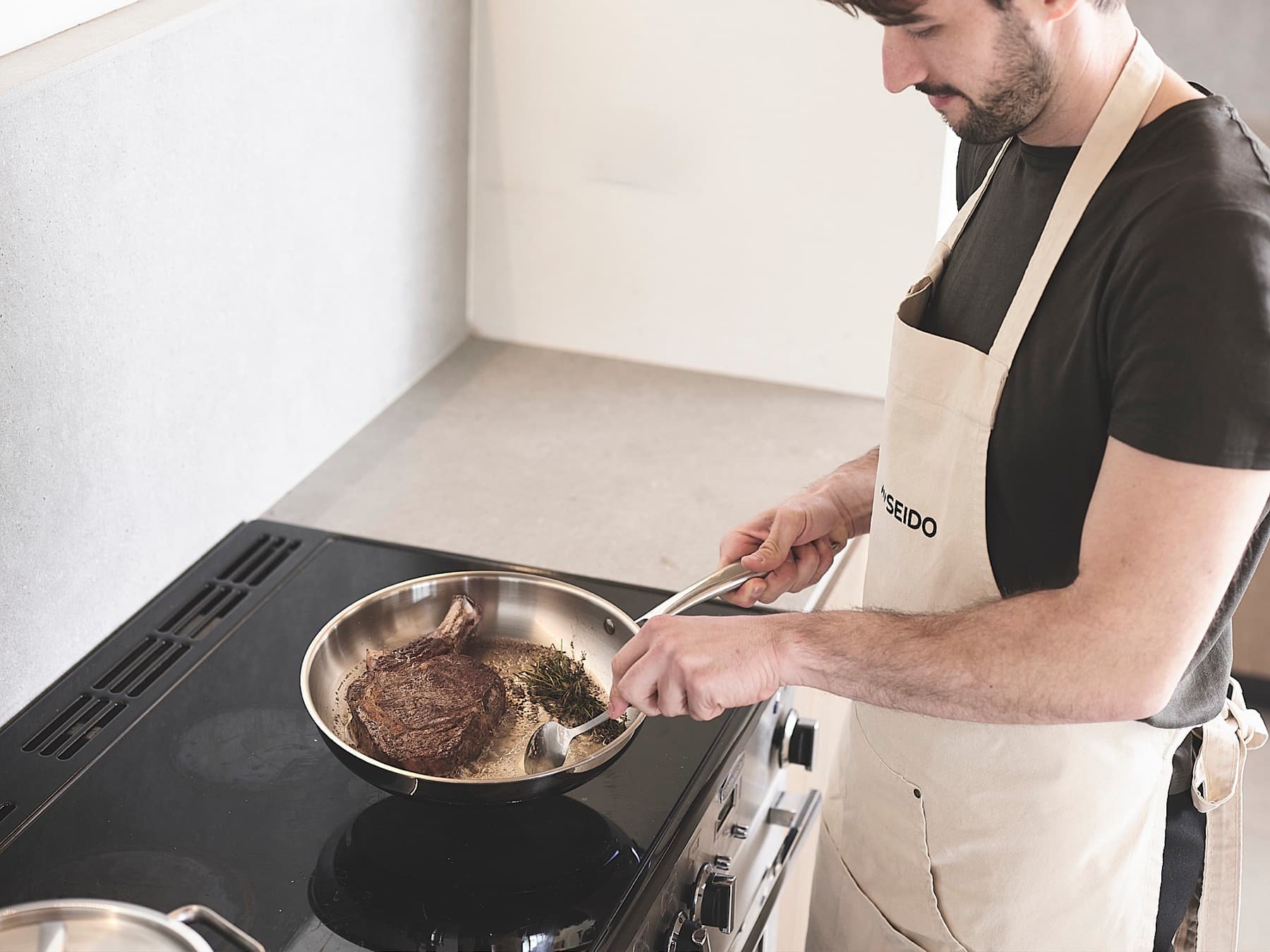
3-ply (tri-ply) stainless steel bonds one aluminum core between two layers of steel; 5-ply adds two more layers for greater heat spreading and thermal mass. A good 5-ply pan heats more evenly but weighs more and responds more slowly. Construction quality — core thickness, cladding to the rim, a 304 (18/8) food-contact surface — matters more than the number itself.
What does 'ply' mean in stainless steel cookware?
Ply is simply the count of metal layers bonded together in a pan's body. Steel on the outside, something more conductive in the middle. That's the whole mystery — though the marketing does its best to make it sound like more.
Here's why the sandwich exists. Stainless steel is superb at most of a pan's job: it's tough, it doesn't react with tomatoes or wine, and it shrugs off a scouring pad. But it's genuinely bad at one thing — conducting heat. A pan made of steel alone heats in patches, running hot directly over the burner and cooler everywhere else. Aluminum conducts heat many times faster than stainless steel, so bonding an aluminum core inside the steel lets the aluminum spread the heat sideways while the steel does the actual cooking.
Every clad pan you'll meet — 3-ply, 5-ply, 7-ply — is a variation on that one sandwich. The question is never whether the sandwich works. It's how much filling there is, and how far up the pan it goes.
What is 3-ply (tri-ply) stainless steel?
Tri-ply is the original recipe: one layer of aluminum bonded between two skins of stainless steel. Steel, aluminum, steel. It's been the workhorse construction of serious stainless cookware for decades, and most pans sold as 'clad' or 'tri-ply' are exactly this.
What tri-ply does well: it heats up quickly, it answers the dial promptly when you nudge the heat up or down, and it keeps the pan's weight civilized. A well-made tri-ply skillet with a decently thick core handles most of what a home kitchen throws at it — eggs, sauces, a weeknight sear — without complaint.
What is 5-ply stainless steel?
5-ply adds two more layers to the stack — usually alternating steel and aluminum, sometimes aluminum layers of different alloys doing slightly different jobs. Either way, the result is the same in spirit: more conductive metal in the middle, and more total mass overall.
That extra metal changes how the pan behaves. Heat spreads farther before it reaches your food, which flattens out hot spots. And the added thermal mass acts like a flywheel: when a cold steak lands, the pan's temperature dips less and recovers sooner, because there's simply more stored heat to draw on.
The honest flip side: a 5-ply pan of the same size is thicker, heavier, slower to heat up, slower to cool down, and — no surprise — more expensive to make.
Is 5-ply better than 3-ply?
Better at some things, worse at others. This is physics, not tiers of luxury.
5-ply wins on evenness and steadiness. More conductive core means fewer hot spots; more mass means the temperature holds when food hits the surface. If your cooking leans on searing, browning, and confident steady heat, mass is your friend.
3-ply wins on response and effort. Less mass means the pan reacts the moment you cut the heat under a cream sauce that's thinking about breaking — and it means less weight on your wrist every time you lift, tilt, or wash the thing. That sounds trivial until you've tossed vegetables one-handed in a heavy pan a few nights running.
So the question isn't which number is bigger. It's which trade-off suits how you actually cook.
Tri-ply vs 5-ply: what matters more than the count
Here's the part the box tends to skip: ply count is one of the least informative numbers on it. Two pans can both say '5-ply' and behave completely differently, because the count says nothing about how much conductive metal is in the stack or where it goes. When you're comparing pans, these are the things that actually move the needle:
- Total aluminum core thickness. The aluminum does the heat spreading, so the amount matters more than how it's subdivided. A tri-ply pan with a thick core can outperform a 5-ply pan with thin ones.
- Cladding to the rim. Fully clad pans carry the layers up the sidewalls, so the whole pan cooks. A disc-bottom pan has its conductive layer only in a plate under the base — step off the disc and you get a scorch ring where sauces catch at the edge.
- Bond quality. The layers have to stay bonded through years of heating and cooling. A poorly bonded pan can separate at the base, and no layer count rescues that.
- The food-contact surface. 304 (18/8) stainless steel is the grade to look for on the inside: enough chromium to self-protect against corrosion, enough nickel to resist staining, and no coating between the metal and your food.
- The boring fundamentals. A base that stays flat on the stovetop, a comfortable riveted handle, a rim that pours without dribbling. None of this shows up in the ply number. All of it shows up at dinner.
So which should you choose?
For most home cooks, either construction serves well when it's made properly — and neither rescues a pan that isn't. Judge the whole build, not the layer count. If you can, pick the pan up: a skillet you'll happily lift at 9 pm on a Tuesday beats a technically superior one that stays in the cupboard. Say it's a 9.5 in (24 cm) skillet — hold it one-handed, tilt it, imagine it full of food. Your wrist gets a vote.
And whatever the layer count, the surface your food touches is where the everyday experience lives. Our Sear Series skillets are built on exactly that principle: an uncoated 304 (18/8) stainless steel cooking surface, made without intentionally added PFAS, oven-safe for stovetop-to-oven cooking, and backed by a 5-Year Warranty. Preheat properly, use enough fat, and the steel does the rest.
Cooking this way is what our 9.5-inch stainless steel skillet is built for — 9.5 in (24 cm), 304 (18/8) stainless, oven-safe, 5-year warranty.
Frequently asked questions
- What is tri-ply stainless steel made of?
- Tri-ply (3-ply) bonds one core layer of aluminum between two layers of stainless steel. The steel provides a durable, non-reactive cooking surface; the aluminum core spreads heat sideways so the pan cooks evenly instead of in patches. It's the standard construction for quality clad stainless cookware.
- Is 5-ply cookware worth it over 3-ply?
- It depends on how you cook. 5-ply adds heat evenness and temperature stability, which favors searing and steady high-heat work — at the cost of extra weight, slower response, and a higher price. A well-made tri-ply pan with a thick aluminum core outperforms a poorly made 5-ply pan every time, so judge total construction quality before layer count.
- Does more ply mean a pan heats up faster?
- No — usually the opposite. More layers mean more metal to bring up to temperature, so a 5-ply pan typically heats more slowly than a comparable 3-ply pan. What the extra layers buy is evenness and stability once the pan is hot, not speed.
- What's the difference between fully clad and a disc bottom?
- Fully clad pans carry their bonded layers from the base all the way up the sidewalls, so the entire pan heats. Disc-bottom pans attach a conductive plate only under the base — beyond the disc's edge the thin steel wall runs hot, which is why sauces scorch in a ring at the edge. For even cooking, cladding to the rim matters more than the ply number.
- Is 7-ply or 9-ply better than 5-ply?
- Not automatically. Past a certain point extra layers add weight, cost, and marketing more than performance — what governs heat spreading is the total thickness of conductive core, the bond quality, and whether the cladding runs to the rim. A high layer count with thin cores is a bigger number, not a better pan.
Browse all stainless steel frying pans or keep reading: How to Cook Eggs on Stainless Steel Without Sticking · Why Food Sticks to Stainless Steel Pans · Stainless Steel vs Nonstick Pans.