Stainless Steel vs. Nonstick Pans: An Honest Comparison
Published July 31, 2026 · Updated September 17, 2026
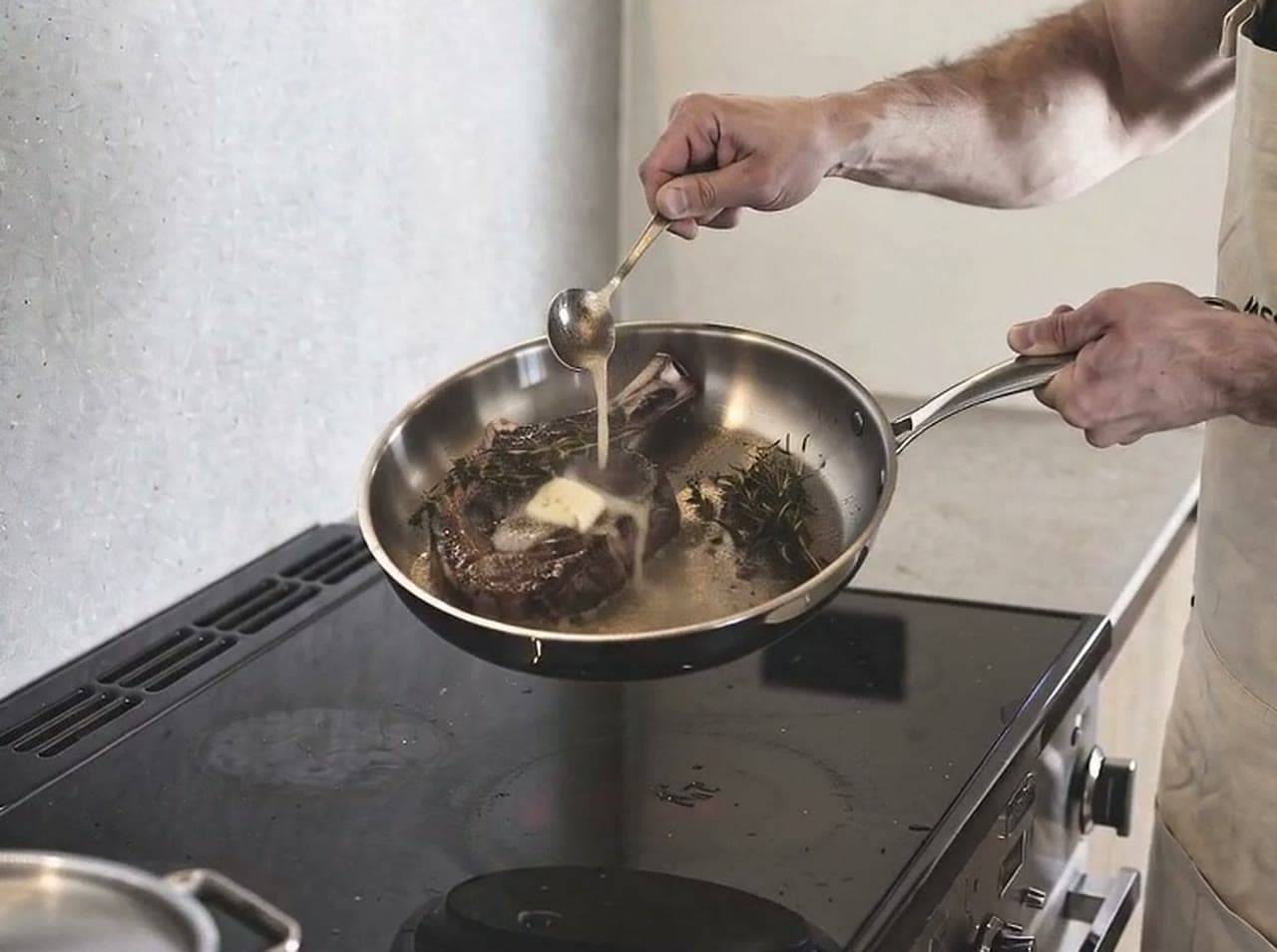
Stainless steel and nonstick pans are different tools, not rivals. A nonstick pan excels at delicate, low-fat release today — eggs slide out with no technique. An uncoated stainless steel pan trades that convenience for high-heat searing, real browning, and a cooking surface that is the pan itself, with no coating to wear away.
That structural difference drives everything else. A nonstick pan's performance lives in a synthetic release layer that wears down with use and can't be renewed. A stainless steel pan's performance lives in technique — preheating, fat, patience — and in a solid metal surface with nothing to wear off.
What is a nonstick coating?
A nonstick coating is a synthetic release layer applied to a metal pan body — most often spun aluminum. The best-known version is PTFE; ceramic sol-gel coatings are the other common type. Either way, the coating is what actually touches your food. The metal underneath supplies the heat; the layer on top supplies the release. Its surface is engineered so proteins and starches can't get a grip, which is why an egg slides across it with almost no fat.
That layer is also the pan's limiting factor. Every use consumes a little of it: utensils score it, abrasive scrubbing thins it, and high heat degrades it. Manufacturers publish care rules — moderate heat, soft tools, gentle washing — because the coating lasts only as long as it's protected. And it can't be renewed. When release fades, no amount of cleaning or conditioning restores it, because the surface itself has worn away. A nonstick pan performs best on its first day and declines from there; the only question is how quickly.
What does stainless steel do better?
High heat, and everything high heat unlocks. An uncoated stainless steel skillet can be preheated hard for searing because there's no coating to protect. That matters for browning: the Maillard reaction — the cascade of flavor-building reactions that turns a steak crust deep brown — wants real surface heat, and stainless delivers it with no release layer in the way.
Stainless also builds fond, the browned glaze of concentrated drippings that clings lightly to the pan as meat sears. On a nonstick surface, fond mostly can't form — the coating is designed to prevent exactly that adhesion. In a stainless pan, you deglaze the fond with stock or wine and you've got a pan sauce in minutes. The stuck bits are an ingredient, not a mess.
Finally, stainless tolerates the treatment coatings forbid. Scorch it, scrub it with an abrasive pad, take it from a hard stovetop sear to broiler-style top-down heat — the cooking surface is solid steel all the way through, so there's no layer to preserve and nothing to ruin by cleaning it properly.
- Searing and browning: hard preheats, real crust, deep Maillard flavor
- Fond and pan sauces: drippings caramelize, then deglaze into flavor
- High-heat technique: stovetop searing through broiler-adjacent finishing
- Cleanup without fear: scrub scorched spots hard — the surface resists staining and has no coating to protect
What does nonstick do better?
Delicate, low-fat release — and it's genuinely better at it. Eggs are the honest test: a nonstick pan turns out an omelet or over-easy eggs with a whisper of butter and no technique at all. Skin-on fish, crepes, and pancakes release just as cleanly. If a food is fragile and lean, nonstick makes it easy on the first try.
Nonstick is also forgiving. It doesn't demand preheating discipline, it wipes clean in seconds, and it never asks you to trust that stuck food will release when it's ready. For a new cook, or a rushed weekday breakfast, that convenience is real. The fair comparison isn't good pan versus bad pan — it's a specialist tool with a consumable surface versus a generalist tool whose surface is the pan itself.
- Eggs, omelets, and crepes with minimal fat and zero technique
- Delicate skin-on fish that would tear if it gripped the pan
- Quick cleanup with a soft sponge
- Forgiving for beginners and rushed mornings
Which should you buy: stainless steel or nonstick?
The honest answer: many kitchens keep one of each. A small nonstick pan handles eggs and delicate fish; an uncoated stainless steel skillet handles searing, sautéing, pan sauces, and everything that benefits from real heat. The two pans even age differently — a nonstick pan gets replaced when its coating wears, while a stainless pan simply gets scrubbed and used again.
If you want a single pan that cooks hot and stays itself, choose uncoated stainless steel. That's the pan we build: skillets in 8-inch (20 cm), 9.5-inch (24 cm), and 11-inch (28 cm) sizes, each with a tri-ply clad body — a 304 (18/8) stainless steel cooking surface, an aluminum core and a 430 stainless steel exterior — and no coating of any kind: made without intentionally added PFAS, without synthetic coatings, and backed by a 5-Year Limited Warranty. The cooking surface is the steel itself, so there's nothing to chip, flake, or wear away — and nothing to baby.
Cooking this way is what our 9.5-inch stainless steel skillet is built for — 9.5 in (24 cm), tri-ply clad, oven-safe, 5-year limited warranty.
Frequently asked questions
- Is a scratched nonstick pan still usable?
- Once a nonstick coating is scratched, blistered, or flaking, the practical answer is replacement. The release layer is the product, and a damaged layer no longer releases evenly — food grips the exposed spots. A worn or scratched coating can't be repaired or reapplied at home, so once release fades, the pan won't improve with cleaning or care.
- Can a stainless steel pan completely replace nonstick?
- For most cooking, yes — with technique. A properly preheated stainless steel skillet with a little fat releases meats, vegetables, and even eggs once you learn to let food finish browning before moving it. The honest exception is delicate, minimal-fat release: an omelet slides out of a nonstick pan with no technique at all. Many cooks keep one small nonstick pan for that job and cook everything else in stainless.
- Are ceramic nonstick pans different from regular nonstick?
- Ceramic nonstick is still a coating — a slick release layer applied over a metal body, made with a different chemistry than traditional nonstick. The wear logic is the same: release is at its best when the pan is new, declines with use, heat, and scrubbing, and can't be renewed once it degrades. A ceramic-coated pan is a different formulation of the same idea, not an uncoated pan.
- Why does food stick to stainless steel?
- Food sticks to stainless steel when proteins bond to a surface that's too cool or too dry. The fix is technique: preheat the dry pan over medium heat until a drop of water beads and glides (the Leidenfrost effect), add oil, then add food and leave it alone. Properly browned food releases on its own — sticking is usually a signal that it isn't ready to turn.
- What should I look for in a non-Teflon pan?
- If you're searching for a pan without Teflon or any other nonstick coating, uncoated stainless steel is the main category to consider: there's no release layer to wear, flake, or lose its properties over time. Look for a food-contact grade alloy — 304 (18/8) stainless steel is the standard — a full-body construction that heats evenly, and an honest account of how the surface behaves: bare steel asks for a proper preheat and a little fat, and gives clear feedback while you cook.
- Do SEIDO skillets have Teflon or a nonstick coating?
- No. The cooking surface is bare 304 (18/8) stainless steel with no coating of any kind — no traditional nonstick and no ceramic release layer. SEIDO skillets are made without intentionally added PFAS and without synthetic coatings, so there's nothing on the surface to degrade and nothing whose condition you need to monitor.
Browse all stainless steel frying pans or keep reading: How to Cook Eggs on Stainless Steel Without Sticking · Why Food Sticks to Stainless Steel Pans · Is Stainless Steel Cookware Safe?.