Materials & Safety: What SEIDO Cookware Is Made Of
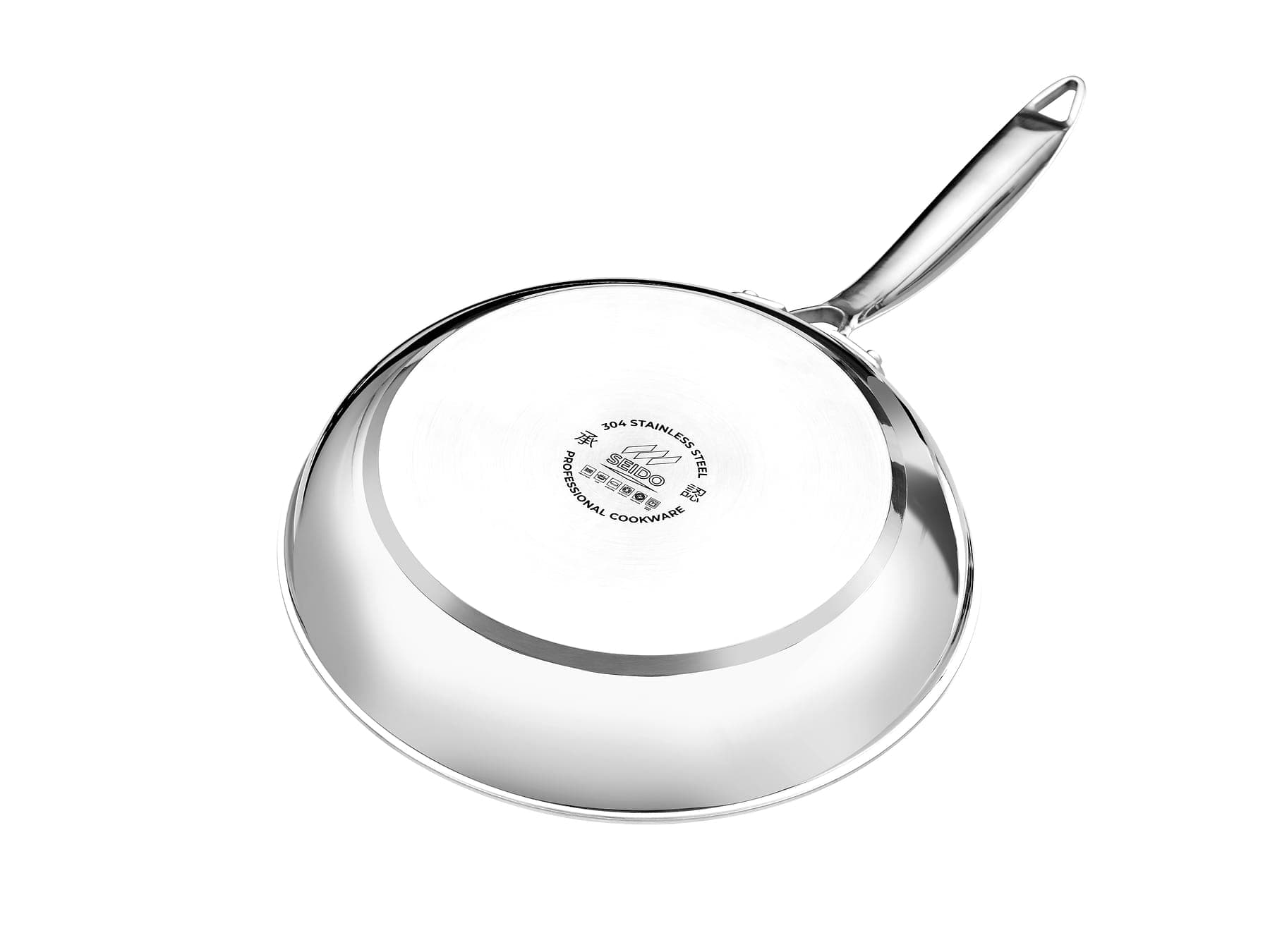
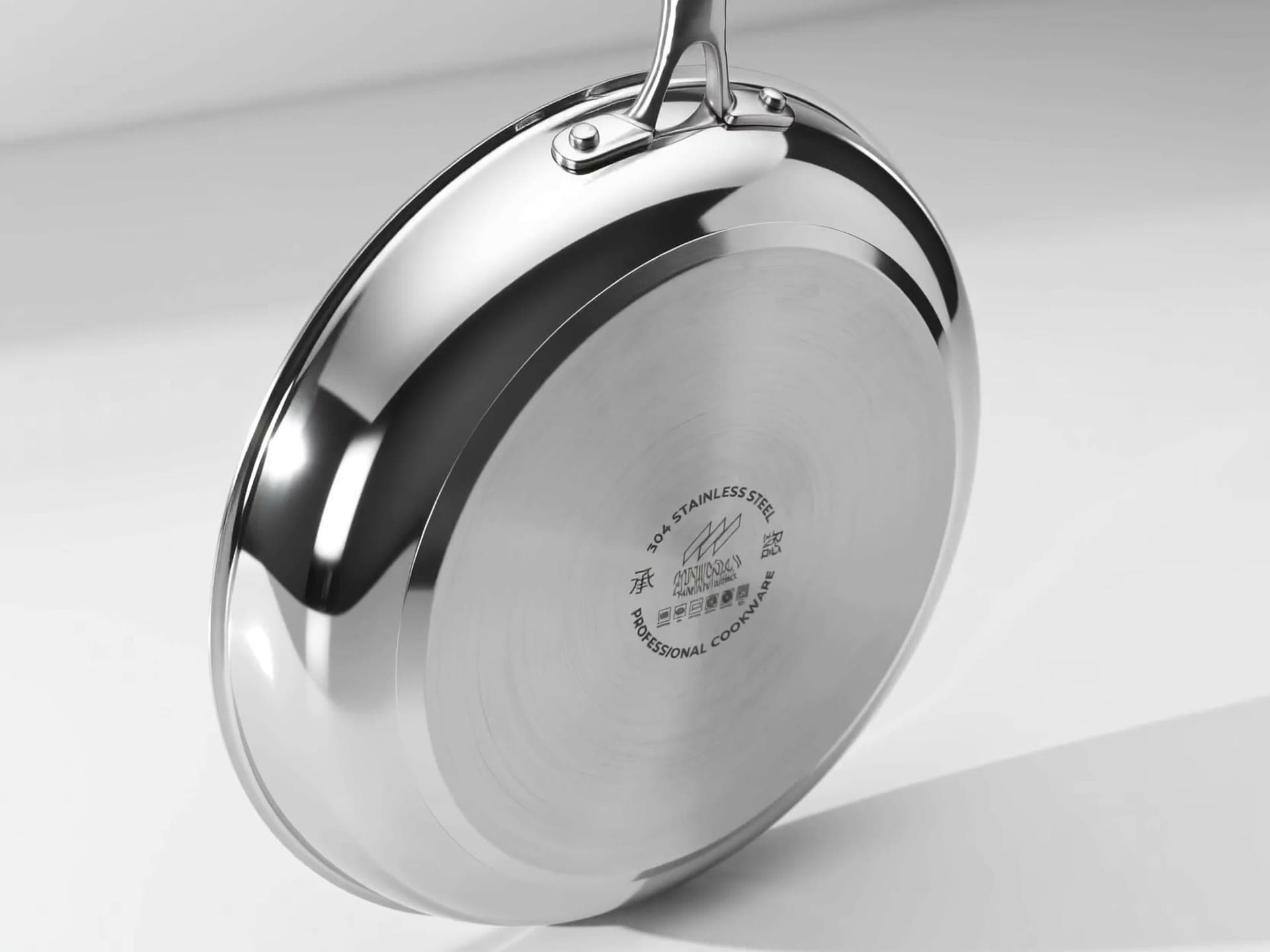
Uncoated 304 (18/8) stainless steel is the established food-contact grade used in commercial kitchens, food processing equipment, and everyday silverware. Its 18% chromium forms a self-renewing passive layer that keeps the surface stable in contact with food, with no coating to scratch, flake, or wear away. SEIDO Cookware skillets have a tri-ply clad body: a 304 (18/8) stainless steel cooking surface, an aluminum core and a 430 stainless steel exterior; the lunch box containers are 304 (18/8) food-grade stainless steel. Both are uncoated, without synthetic coatings, and made without intentionally added PFAS — and the lunch box container steel has been lab-tested against the US FDA specification for total chromium.
This page explains what those terms mean and why they matter: what 304 (18/8) stainless steel is, how the chromium passive layer works, where PFAS actually appear in cookware, and how California's Proposition 65 applies.
What are SEIDO Cookware products made of?
The SEIDO Cookware range is deliberately simple: three uncoated stainless steel skillets — 8-inch (20 cm), 9.5-inch (24 cm), and 11-inch (28 cm) — and a stainless steel lunch box 3-pack, 27 oz (800 ml) each. Every product is made without synthetic coatings and without intentionally added PFAS: the skillets are tri-ply clad, with a 304 (18/8) stainless steel cooking surface, and the lunch box containers are 304 (18/8) food-grade stainless steel.
The skillets' cooking surface is bare 304 stainless steel — the same grade used across commercial kitchens and food processing equipment. The lunch boxes are built for adult routines — office, gym, commute, and weekly meal prep — and are microwave-safe by design. Every product is backed by a 5-Year Limited Warranty.
What does 304 (18/8) stainless steel mean?
304 stainless steel is the standard food-contact grade of stainless steel. The designation 18/8 refers to its composition: roughly 18% chromium and 8% nickel, alloyed with iron. The two names describe the same material — 304 is the technical grade, 18/8 is the composition shorthand.
Chromium is what makes stainless steel stainless. At 18%, it reacts with oxygen to form a passive layer — an invisible, self-renewing film of chromium oxide only a few nanometers thick. This layer separates the steel from whatever touches it and re-forms on its own if the surface is scratched or polished.
Nickel stabilizes the steel's structure and improves its corrosion resistance, which is why 18/8 is the standard for equipment that touches food: commercial kitchens, food processing lines, and everyday silverware.
- 18% chromium — reacts with oxygen to form the passive layer that makes the steel stainless
- 8% nickel — stabilizes the alloy and adds corrosion resistance
- Iron — the balance of the alloy, with small, tightly controlled additions
Does stainless steel cookware contain PFAS?
PFAS (per- and polyfluoroalkyl substances) are a family of synthetic compounds used in many nonstick coatings. In cookware, PFAS are a coating question — they are associated with the applied layer, not with the metal beneath it.
Uncoated stainless steel has no coating to contain them. The cooking surface of a SEIDO Cookware skillet is bare 304 (18/8) stainless steel, and SEIDO Cookware products are made without intentionally added PFAS and without synthetic coatings. For shoppers searching for cookware made without intentionally added PFAS, uncoated stainless steel is a direct answer: no applied layer, no place for coating chemistry to live.
Our wording is deliberate. 'Made without intentionally added PFAS' describes exactly what we control — our materials and our manufacturing process — without overstating what any manufacturer can measure to absolute zero. We hold precision in claims to the same standard as precision in products.
Why does SEIDO Cookware make uncoated skillets?
A coated frying pan's performance depends on a layer applied to its surface — and that layer is the weak point. Coatings can scratch, flake, and degrade with heat and use. When the coating goes, the pan goes with it.
An uncoated skillet removes the problem instead of managing it. There is no applied layer, so there is no coating to flake into food, scratch off, or degrade with normal use. The cooking surface is the material itself: 304 (18/8) stainless steel. Food release comes from technique — proper preheating and a little oil — not from a coating with a shelf life.
How does SEIDO Cookware verify its materials?
We publish what our products are made of, and we test it. The 304 stainless steel of our lunch box containers has been lab-tested against the US FDA specification for total chromium, and the report is published on this page.
We name the alloy, we state the composition, and we give measurements in plain units. Materials questions deserve materials answers.
What is California Proposition 65?
Proposition 65 — formally the Safe Drinking Water and Toxic Enforcement Act of 1986 — is a California right-to-know law. It requires businesses to notify Californians about potential exposure to substances on a state-maintained list. The list is long, covers many substances found in everyday products and foods, and California sets its own intentionally conservative warning thresholds.
Because the thresholds are conservative, Proposition 65 warnings appear on a wide range of ordinary household products. A warning is a disclosure required by California law. We treat it the way we treat every materials question: follow the rule, show the information, and let you read it in context.
Where a Proposition 65 warning applies to a specific product, it appears on that product's packaging and Amazon listing.
The documents
Verified, not claimed
- Finished product testLunch box — dishwasher resistance (EN 12875-1)An independent laboratory tested the finished stainless steel container to EN 12875-1:2005 mechanical dishwashing resistance — 50 cycles. Result: Pass. Report SHHL2406033783CW.Independent test laboratory · Jul 2, 2024
- Finished product testLunch box — microwave safety testIndependent laboratory microwave safety test on the finished stainless steel container. Result: Pass. Report TJHL2406005341CW.Independent test laboratory · Jun 24, 2024
- Finished product testLunch box — oven test (container only)Independent laboratory oven test on the finished stainless steel container. Result: Pass. Applies to the container without its lid. Report TJHL2406005340CW.Independent test laboratory · Jun 24, 2024
- Finished product testLunch box — refrigerator and freezer safetyIndependent laboratory refrigerator safety test on the finished stainless steel container. Result: Pass. Report SHHL2407037511CW.Independent test laboratory · Jul 12, 2024
- Material testStainless steel — US FDA GRAS chromium specificationAn independent laboratory tested the container's stainless steel against the US FDA Generally Recognized As Safe specification for total chromium content. Result: Pass. Report SHAHL25013778101.Independent test laboratory · Jun 13, 2025
- Component testLid — FDA food-contact test (glass, frame and gasket)Independent laboratory FDA food-contact testing of the complete lid: transparent glass, black PP frame and black silicone sealing gasket, each tested separately. Report TSNH00556105.Independent test laboratory · Aug 18, 2025
Verified, not claimed.
A 304 (18/8) stainless steel cooking surface on every skillet, 304 (18/8) food-grade stainless steel lunch box containers, made without intentionally added PFAS. The third-party test documents are published for you to read.
Frequently asked questions
- Is 304 stainless steel safe for cooking?
- 304 (18/8) stainless steel is the standard food-contact grade of stainless steel, used in commercial kitchens, food processing equipment, and everyday silverware. Its 18% chromium content forms a passive chromium oxide layer that keeps the surface stable in contact with food. SEIDO Cookware skillets have a 304 (18/8) stainless steel cooking surface, the lunch box containers are 304 (18/8) food-grade stainless steel, and the lunch box container steel has been lab-tested against the US FDA specification for total chromium.
- What is the difference between 18/10 and 18/8 stainless steel?
- Both are food-grade. The numbers describe composition: the first is chromium content, the second is nickel. 18/8 (grade 304) contains roughly 18% chromium and 8% nickel; 18/10 contains the same chromium with slightly more nickel, which adds a small margin of corrosion resistance and a slightly brighter finish. In practice the two perform very similarly, and both are standard choices for cookware and flatware.
- Does SEIDO Cookware use nonstick coatings?
- No. SEIDO Cookware is uncoated by design. The cooking surface of every skillet is bare 304 (18/8) stainless steel — without synthetic coatings, and made without intentionally added PFAS. With no applied layer, there is no coating to flake, scratch off, or degrade over time. Food releases through technique: proper preheating and a small amount of oil, rather than a coating that eventually wears out.
- What is the passive layer on stainless steel?
- The passive layer is an ultra-thin film of chromium oxide that forms naturally on stainless steel when the chromium in the alloy reacts with oxygen. It is what makes stainless steel resistant to rust and corrosion. The layer is self-renewing: if the surface is scratched or scoured, the exposed chromium reacts with oxygen and the film re-forms. It requires no coating or treatment to exist.