What to Look For in a Clad Stainless Steel Skillet
Published September 17, 2026 · Updated October 6, 2026
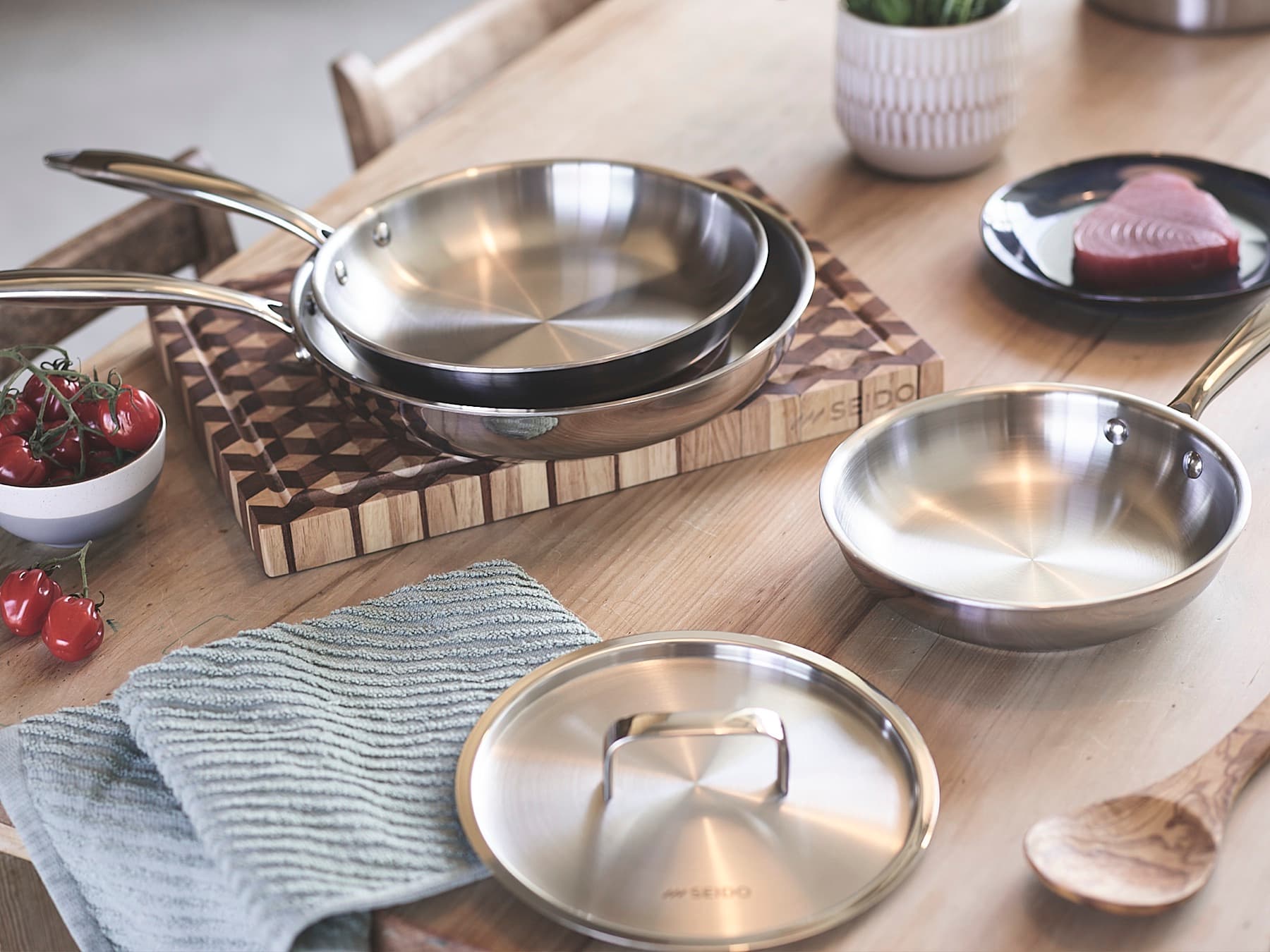
A good clad stainless steel skillet has a conductive core that runs up the walls, not just across the base, a 304 stainless cooking surface, a base that sits flat, a securely fixed handle, a lid that fits, and a warranty that says plainly what it covers.
What does "clad" mean on a stainless steel skillet?
Stainless steel is durable and easy to care for, but it moves heat slowly. Aluminum conducts heat more than ten times as well, and copper better still. Clad cookware bonds a layer of one of those conductive metals between sheets of stainless steel, so the pan spreads heat like aluminum while you cook on stainless steel. The layers can show as a thin line at the cut rim, and on our skillets they do.
There are two common ways to do this, and they cook differently. A fully clad skillet carries the bonded layers across the base and all the way up the walls to the rim. A disc-base (sometimes called impact-bonded or encapsulated) skillet has a single-layer stainless body with a thick conductive disc attached to the underside of the base only.
Disc bases can heat the flat center well, but the walls stay thin steel, so heat drops off where the disc ends. That matters in a skillet, where you sear across the whole floor and toss food up the sides. A fully clad body heats more evenly edge to edge and responds more predictably when you turn the burner up or down.
- Look at the rim. On many fully clad pans you can see the layer lines where the metal is cut.
- Look at the underside. A disc base usually shows as a raised plate with a visible seam or step near the edge of the floor.
- Read the description for where the layers run. "Fully clad" or "clad to the rim" is a different construction from "encapsulated base".
Is 18/10 stainless steel better than 18/8?
Not in any way that matters much at the stove. Both stamps describe the same alloy family: type 304 austenitic stainless steel, the grade most widely used for food-contact cookware. The numbers are shorthand for roughly 18% chromium and 8% or 10% nickel. The ASTM A240 specification allows 304 a nickel content of 8.0% to 10.5%, so 18/8 and 18/10 are both inside the same grade rather than two rungs of a ladder.
Chromium forms the thin, self-repairing oxide film that makes the steel stainless. Nickel helps keep the steel's structure stable and adds some corrosion resistance and luster. A couple of extra points of nickel can make a small difference to how bright the surface stays over years, but the core layer, the thickness and the build quality affect how a skillet cooks far more than 18/8 versus 18/10.
Two other stamps are worth recognizing. 18/0, often sold as type 430, has almost no nickel and is magnetic, which is why it often appears on the outside of pans meant for induction cooktops. Type 316 adds molybdenum for extra resistance to salt and chlorides; it shows up occasionally in cookware and costs more.
How do you check that a skillet's base is flat?
A skillet only browns evenly where it touches the heat. On glass, ceramic and induction cooktops, contact is direct, so a base that rocks or bows leaves cool patches.
Set the pan on a flat counter and press gently on opposite sides of the rim. It should not rock. If you can, lay a straight edge across the underside and look for light under it. At home, a thin film of oil tells the same story: if it runs to the edges and pools in a ring, the center is domed.
Flatness is also something you protect. Plunging a hot pan into cold water, or heating an empty pan on high for a long time, is how skillets warp. Let the pan cool before washing and preheat over medium.
Riveted or welded handle: what details should you check?
The handle is the part you notice every day, so it deserves a close look. Riveted handles are fixed with metal rivets through the wall of the pan and are very secure. The trade-off is that the rivet heads sit inside the pan, where food can collect around them. Welded handles leave a smooth interior but depend on the quality of the weld.
Hold the skillet the way you would when it is full. A handle angled slightly upward keeps your hand away from the burner and gives leverage for tossing. A rounded or channeled grip is less likely to twist in your hand than a flat bar. Some larger skillets add a small helper handle opposite the main one; check the loaded weight either way.
Any metal handle can get hot on the stove and will get hot in the oven. Keep a dry towel or oven mitt within reach whatever the design.
How heavy should a stainless steel skillet be?
Weight is a rough proxy for how much metal is in the pan, and metal is what stores and spreads heat. A skillet that feels thin and light will usually swing in temperature when cold food goes in, and it is more prone to hot spots and warping.
Heavier is not automatically better. A skillet you can't lift comfortably with one hand is a skillet you will avoid. The useful test is balance: pick the pan up by its handle and see whether it pulls sharply downward at the front.
Should a stainless steel skillet come with a lid?
A lid turns a skillet into a pan you can braise, steam and gently finish in. It keeps splatter down and lets you cook eggs through without flipping them. Many skillets are sold without one, and a lid bought separately rarely fits as closely.
If a lid is included, check that it sits level on the rim without rocking and that its handle is fixed securely. Glass lids let you watch the food without lifting them; stainless lids are harder to break. Check the maker's instructions for the lid separately from the pan, because the two often have different oven limits.
What should a cookware warranty and origin label tell you?
A warranty is only as useful as its terms. Read what it covers, usually defects in materials and workmanship, and what it excludes, which commonly includes discoloration, scratches, damage from overheating or misuse, and ordinary wear. Check how you make a claim and whether you need proof of purchase. Under the Magnuson-Moss Warranty Act, the FTC requires written warranty terms for consumer products costing more than $15 to be available to read before you buy, so a seller should be able to show you the document.
US customs law (19 U.S.C. 1304) generally requires imported goods, or their containers, to be marked with the country of origin so the final buyer can see it. Where a pan is made tells you less about its quality than its construction does, but a brand that states it plainly on the product and the listing is being straight with you, and that is a fair signal about everything else it says.
Which SEIDO skillet size should you choose?
SEIDO skillets come in 8 in (20 cm), 9.5 in (24 cm) and 11 in (28 cm), and each is sold with a lid. Each has a tri-ply clad body: a 304 (18/8) stainless steel cooking surface over an aluminum core. Induction compatibility is not yet confirmed for each size, so SEIDO makes no induction claim. The cooking surface is uncoated, with no synthetic coating. Every skillet carries a 5-Year Limited Warranty, and SEIDO cookware is made in China. The name comes from the Japanese word for precision, 精度. The 11 in (28 cm) skillet is the size to look at if you cook for more than two; see price on Amazon.
Cooking this way is what our 11-inch stainless steel skillet is built for — 11 in (28 cm), tri-ply clad, oven-safe, 5-year limited warranty.
Frequently asked questions
- Is a fully clad skillet worth it over a disc-base skillet?
- For a skillet, usually yes. A disc base heats the flat center but leaves thin single-layer steel walls, so heat falls off toward the edges. A fully clad skillet carries its conductive core up to the rim, which gives more even browning across the whole floor and steadier control when you adjust the burner.
- What is the difference between 18/8 and 18/10 stainless steel?
- Both are type 304 stainless steel. The numbers are shorthand for roughly 18% chromium and 8% or 10% nickel, and the ASTM A240 specification allows 304 between 8.0% and 10.5% nickel. The slightly higher nickel in 18/10 can help luster over time, but construction and thickness matter far more to how a skillet cooks.
- Do uncoated stainless steel skillets need seasoning?
- No. Unlike cast iron or carbon steel, stainless steel does not need a seasoning layer to protect it from rust or to cook well. Food release comes from technique: preheat the dry pan until a drop of water beads and glides, add fat, let it shimmer, then add the food.
- How can I tell if a stainless steel skillet works on an induction cooktop?
- Check the maker's own statement first: the induction symbol on the pan or packaging, or induction listed in the product details. Induction needs a magnetic base, so a fridge magnet that grips the underside firmly is a useful quick check, but a weak grip can mean poor performance, and only the maker's statement confirms it.
- What size stainless steel skillet should I buy first?
- A skillet around 10 to 11 in (25 to 28 cm) across the top suits most everyday cooking for two to four people: searing, sautéing vegetables and making a pan sauce. An 8 in (20 cm) skillet is handy for eggs and single portions, and larger pans help when you cook in bigger batches.
Browse all stainless steel frying pans or keep reading: How to Cook Eggs on Stainless Steel Without Sticking · Why Food Sticks to Stainless Steel Pans · Stainless Steel vs Nonstick Pans.