Why Food Sticks to Stainless Steel Pans — and How to Stop It
Published July 31, 2026 · Updated September 17, 2026
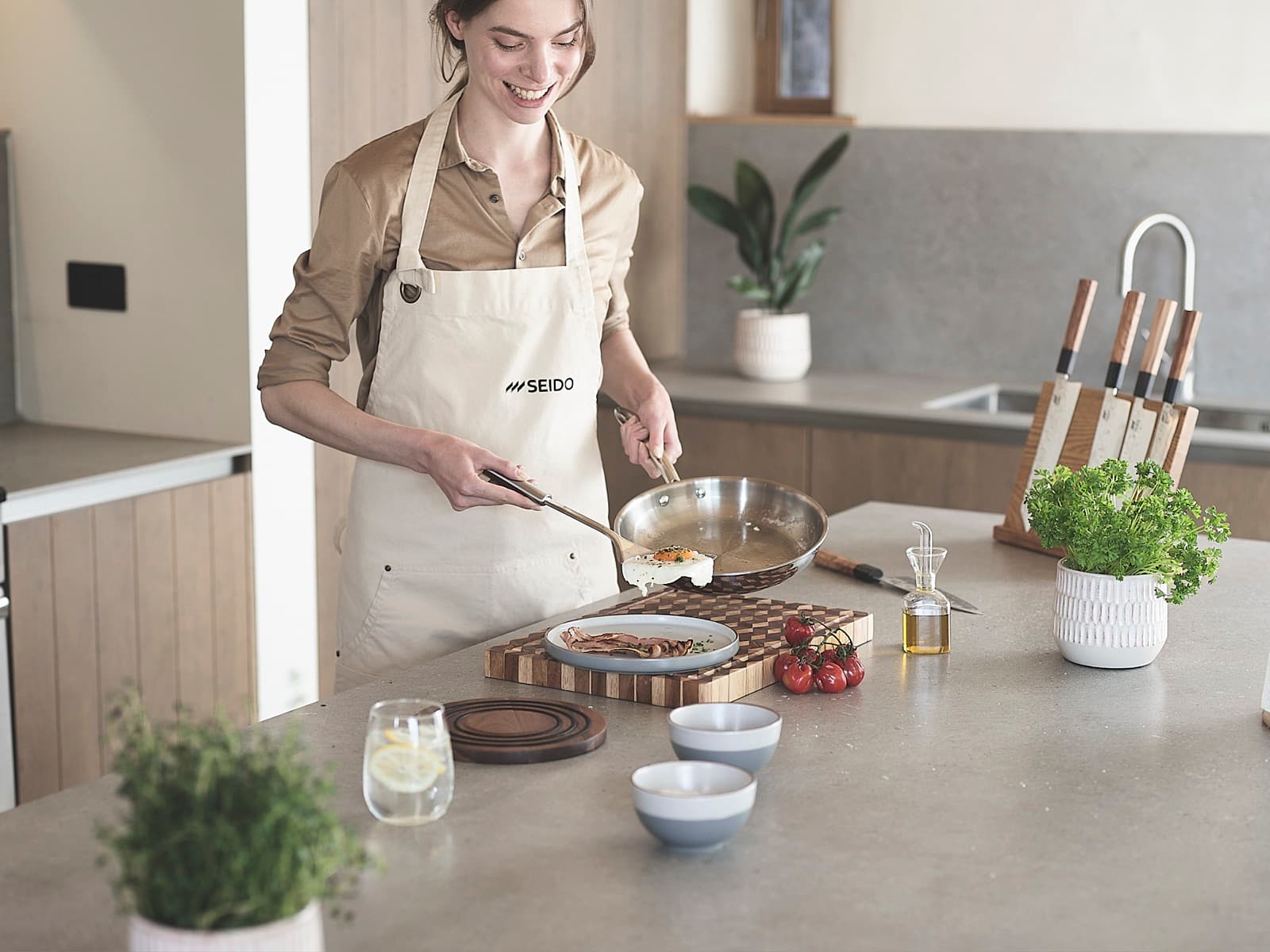
Food sticks to stainless steel when proteins bond to a surface that's too cool or too dry. Enough preheating turns the moisture in your food into a vapor cushion, and a thin layer of fat fills the steel's microscopic texture, so food browns instead of bonding. Heat first, then fat, then food.
Sticking isn't a defect of the pan. Bare stainless steel has no coating to compensate for a cold or dry surface, so it rewards correct technique — and that same bonding, managed on purpose, is what builds fond, the browned layer behind every pan sauce.
What actually makes food stick to a pan?
Sticking is adhesion — food forming real bonds with the metal surface. Proteins are the main culprits. When protein-rich foods like eggs, chicken, and fish touch bare metal, their proteins can bond directly with atoms at the pan's surface. Sugars in marinades and glazes do something similar as they concentrate and turn tacky.
Temperature decides whether that bond forms. On a pan that's too cool, moisture from the food wets the surface, proteins settle into intimate contact with the metal, and as the pan slowly climbs in heat, they set in place — locked on. On a properly preheated pan, the bond never gets the chance to form.
What happens on the surface of stainless steel when you cook?
Even a polished stainless steel skillet isn't perfectly smooth. At microscopic scale, the surface is a landscape of tiny peaks and valleys. Food pressed into that texture has enormous contact area — ideal conditions for bonding if nothing intervenes.
Two things intervene: heat and fat. A properly preheated pan flashes the moisture at the food's surface into steam the instant they meet, creating a thin vapor cushion that holds the food just off the metal. Fat does the rest — it flows into those microscopic valleys, levels the texture, and forms a slick, heat-conducting layer between food and steel.
The order matters: heat first, then fat, then food. Fat added to a cold pan just sits under the food while the surface slowly warms — which is exactly the window in which proteins bond.
How do you know when a stainless steel pan is hot enough? The water test
The water test uses the Leidenfrost effect to read pan temperature without a thermometer. Heat the dry skillet over medium heat for two to three minutes, then flick in a few drops of water and listen.
If the drops spread, hiss, and evaporate, the pan's still too cool — the water is simply boiling off on contact. Keep heating. Once the surface climbs well above water's boiling point of 212°F (100°C), the underside of each drop vaporizes instantly and the drop rides its own steam cushion: it pulls into a bead and glides around the pan like a marble. That gliding bead is your signal — the same vapor-cushion physics that will keep your food from bonding.
When the water beads, wipe or evaporate it off, add your fat, and let it shimmer. Then add the food. If the pan ever smokes hard, it has overshot — lift it off the heat for a moment before continuing.
Why is food sticking to the pan sometimes a good thing?
Controlled sticking is how flavor gets built. Sear a steak or a chicken thigh in stainless steel and it grips the pan at first — then, as the crust browns and dries, it releases on its own. That grip-then-release cycle is exactly the surface contact deep browning requires.
The browned bits left behind are fond — concentrated, caramelized residue that's stuck-then-released flavor waiting to be used. Pour a splash of wine, stock, or even water into the hot pan, scrape with a wooden spoon, and the fond dissolves into the base of a pan sauce. That's deglazing, and it's why many cooks choose uncoated stainless steel on purpose: a coated pan is designed to prevent the very contact that builds fond.
When does sticking mean technique — and when does it mean the pan?
On clean, undamaged stainless steel, sticking means technique, not equipment. There's no coating to fail, so there's nothing on the pan that wears out and causes sticking. Run through this checklist before blaming the skillet:
Fix the inputs and the same pan behaves completely differently. That responsiveness — the pan telling you plainly whether the technique was right — is why stainless steel is the surface cooks learn on and stay on.
- The pan wasn't preheated — the first thing to check. Use the water test.
- The food was cold and wet. Pat it dry and let it lose its refrigerator chill before it hits the pan.
- It was moved too soon. Seared proteins release themselves when the crust forms; forcing an early flip tears the bond open.
- The pan was overcrowded. Too much food drops the surface temperature and traps steam, so nothing browns.
- Too little fat. The fat layer is the lubricant that levels the steel's microscopic texture.
- The heat ran away. Scorched sugars and burnt fat turn tacky; medium to medium-high covers most searing.
What kind of skillet makes this easiest to practice?
A bare, uncoated skillet gives the clearest feedback: the water test reads true, fond builds properly, and the release cue is unmistakable. SEIDO skillets are made for exactly this style of cooking — uncoated, with a tri-ply clad body: a 304 (18/8) stainless steel cooking surface, an aluminum core and a 430 stainless steel exterior. They are made without intentionally added PFAS and without synthetic coatings. With no coating on the cooking surface, there's nothing to wear away and change how the pan behaves over time, and each skillet is backed by a 5-Year Limited Warranty.
Start with the water test, and the pan will teach you the rest.
Cooking this way is what our 9.5-inch stainless steel skillet is built for — 9.5 in (24 cm), tri-ply clad, oven-safe, 5-year limited warranty.
Frequently asked questions
- Is a stainless steel pan that sticks defective?
- No. Sticking on stainless steel is almost always technique, not equipment. Bare steel has no coating to mask a pan that's too cool, food that's too wet, or a flip attempted too early. Preheat until water beads and glides, add fat and let it shimmer, dry the food, and let it release on its own.
- Why doesn't food stick to nonstick pans?
- Nonstick pans are coated with a synthetic polymer that fills the metal's microscopic texture and resists bonding with food. The tradeoff is that the coating itself does all the work, and coatings wear: heat, utensils, and washing gradually degrade the surface, and the release property fades with it. Bare stainless steel has no coating layer to lose.
- Can you season a stainless steel pan like cast iron?
- Not in any lasting way. Cast iron's rough, porous surface holds polymerized oil through repeated use; stainless steel is far smoother and denser, so oil layers largely wash away. A quick film of oil can help in the moment, but the reliable method on stainless is clean steel plus technique: a proper preheat, enough fat, dry food, and patience.
- Why do eggs and fish stick more than other foods?
- They're high in protein and moisture with delicate structures. Proteins bond readily to metal, and moist, tender foods spend longer wet against the surface before a crust forms. They demand the most faithful technique: a fully preheated pan, fat that's shimmering, a patted-dry surface on the food, and no early flipping.
Browse all stainless steel frying pans or keep reading: How to Cook Eggs on Stainless Steel Without Sticking · Stainless Steel vs Nonstick Pans · Is Stainless Steel Cookware Safe?.