What Is 18/8 Stainless Steel — and Why Is It Also Called 304?
Published July 31, 2026 · Updated September 17, 2026
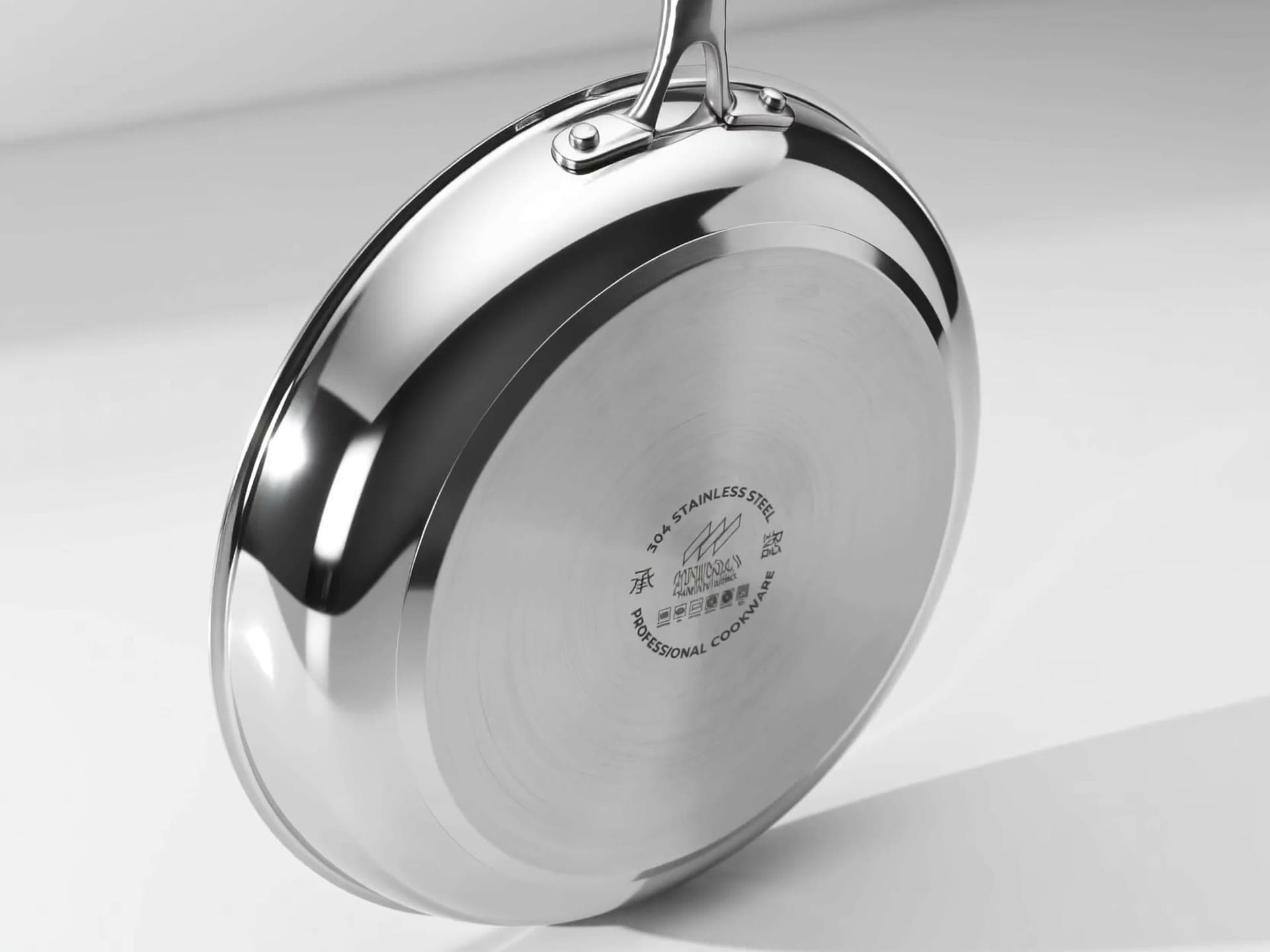
18/8 stainless steel is an alloy containing roughly 18% chromium and 8% nickel. It's the same grade commonly designated 304 — the two names describe one material. Chromium provides corrosion resistance; nickel stabilizes the steel's internal structure. It's a standard food-contact stainless steel used widely in cookware, utensils, and food equipment.
What does the 18/8 in stainless steel mean?
The numbers are a recipe. 18/8 names the two alloying elements that define the steel: about 18% chromium and 8% nickel, with the balance mostly iron plus small amounts of carbon, manganese, and silicon. That composition places the alloy in the austenitic family of stainless steels — the group known for formability, toughness, and corrosion resistance.
The same steel carries different names depending on which naming system you meet it in. "18/8" is the traditional shorthand built directly from composition. "304" is the grade designation from the American SAE/AISI numbering system. European standards list it as 1.4301, and fastener markings abbreviate it as A2. All of these point to the same material.
You encounter 18/8 constantly, whether you've noticed or not: cookware, mixing bowls, sinks, water bottles, flatware, and commercial food-processing equipment. It became the default food-contact stainless steel because it pairs reliable corrosion resistance with the formability manufacturers need to press, draw, and weld it into finished goods.
- 18 = approximately 18% chromium — the element that makes steel "stainless"
- 8 = approximately 8% nickel — the element that stabilizes the steel's structure
- Same grade, other names: 304 (SAE/AISI), 1.4301 (European standard), A2 (fastener marking)
What does chromium do in stainless steel?
Chromium is what earns the "stainless" name. Once chromium content passes a threshold of roughly 10.5%, the chromium atoms at the steel's surface react with oxygen in the air and form an extremely thin, invisible film of chromium oxide. Metallurgists call this the passive layer, and it's the mechanism behind nearly everything stainless steel is known for.
The passive layer seals the iron beneath it away from air and moisture, so the reactions that produce rust never get started. Crucially, the layer forms spontaneously wherever chromium meets oxygen — which means it self-repairs. Scratch the surface, and a fresh oxide film forms across the newly exposed metal within moments. The protection is built into the alloy itself, not applied on top of it.
This is also why stainless steel offers resistance rather than immunity. The passive layer can be challenged by prolonged exposure to chlorides — which is why undissolved salt left sitting in cold water can pit any stainless steel, whatever the brand. Ordinary cooking, washing, and scrubbing pose no such problem: the layer withstands them, and reforms wherever it's disturbed.
What does nickel do in stainless steel?
Chromium alone would make steel corrosion-resistant, but the resulting alloy would have a different internal crystal structure — harder to form, easier to crack. Nickel's job is structural. At around 8%, it stabilizes what metallurgists call the austenitic crystal structure, keeping it in place all the way down to room temperature.
That structure is why 18/8 behaves the way it does in a factory and in a kitchen. Austenitic steel can be deep-drawn into pans and bowls without splitting. It's tough rather than brittle, it doesn't require hardening heat treatments, and it holds its toughness in the cold as well as the heat. Nickel also contributes to the bright, easily polished surface that stainless cookware is known for.
In short: chromium protects the steel, nickel makes it workable and durable. The 18 and the 8 are a partnership, and neither number works as well without the other.
Is 18/10 better than 18/8?
18/10 stainless steel contains the same chromium as 18/8 and roughly two percentage points more nickel. Both are food-grade austenitic stainless steels, both form the identical self-repairing chromium-oxide passive layer, and both belong to the same broad 304 family of alloys.
The extra nickel in 18/10 modestly improves corrosion resistance and gives a slightly brighter polish, which is why 18/10 is common in flatware — where finish is the selling point. For a cooking surface, the practical difference is small. Both grades handle food contact, both resist staining in ordinary kitchen use, and both depend on the same chromium chemistry for their protection.
Neither number is a quality score by itself. How a pan is fabricated — the gauge of the steel, the quality of the finish, the consistency of the forming — matters at least as much as the 8-versus-10 nickel distinction. Treat 18/8 and 18/10 as two entries in the same food-grade family, not as a ranking.
How does this relate to SEIDO Cookware?
Our skillets have a tri-ply clad body: a 304 (18/8) stainless steel cooking surface, an aluminum core and a 430 stainless steel exterior. The cooking surface is the same grade this article describes, and it is uncoated: it's the bare 18/8 steel itself, without synthetic coatings, and made without intentionally added PFAS.
Because the surface is the metal rather than a layer applied to the metal, there's nothing to wear through, flake, or lose performance over time. The chromium-oxide passive layer is the protection, and it renews itself for the life of the pan. That coating-free construction is the basis of the 5-Year Limited Warranty.
The same grade runs across the SEIDO Cookware range: it is the skillets' cooking surface and the steel of the containers in the stainless steel lunch box 3-pack. The full material story is on the materials and safety page.
304 vs 316 stainless steel: what does molybdenum add?
316 is the other stainless grade you'll see on food containers and bottles. Like 304, it's an austenitic stainless steel. The difference is one added element: about 2% to 3% molybdenum.
The ASTM A240 standard sets 316 at roughly 16% to 18% chromium, 10% to 14% nickel, and 2% to 3% molybdenum. 304 has no molybdenum requirement. It carries a little more chromium, from about 17.5% to 19.5%, and less nickel, from 8.0% to 10.5%.
Molybdenum strengthens the passive layer against chlorides, the salts that cause pitting. Engineers compare grades with a figure called the pitting resistance equivalent number. It weights molybdenum at about 3.3 times chromium, so 316 scores several points higher than 304.
That extra resistance matters in chloride-heavy places. Think of seawater, coastal fittings, pool equipment, and some chemical and pharmaceutical plants. It is also used in some food-processing lines that handle hot brines for long periods.
A kitchen skillet or a lunch box container doesn't live in those conditions. Food sits in contact for hours, not months. The steel gets washed and dried between uses. For ordinary cooking and food storage, 304 is the standard food-contact grade, and 316 isn't needed.
One habit matters for both grades. Don't leave salty liquids or undissolved salt sitting in the steel for long periods. Rinse and dry it. That protects 304 and 316 alike.
- 304 (18/8): about 17.5–19.5% chromium, 8.0–10.5% nickel, no molybdenum requirement
- 316: about 16–18% chromium, 10–14% nickel, 2–3% molybdenum
- Choose 316 for long exposure to seawater, brines, or other strong chloride sources
- For everyday cooking and food storage, 304 is the standard food-contact grade
Can you tell 18/8 from 18/10 or 316 by looking at it?
No. 18/8, 18/10, and 316 look the same once they're polished or brushed. A two-point change in nickel doesn't produce a color difference you can see.
A magnet doesn't settle it either. All three grades are austenitic, and in the annealed state they are essentially nonmagnetic. But pressing, drawing, and bending can make 304 weakly magnetic in the worked areas. So a slight pull on a formed bowl or rim doesn't mean the steel is a different grade.
Many skillets add a magnetic stainless layer on the outside, often a 400-series ferritic grade, so the base works on induction cooktops. That exterior can be strongly magnetic while the cooking surface is still austenitic. A magnet test tells you about the layer the magnet touches, not the cooking surface.
The reliable ways to confirm a grade are a chemical analysis or the steel producer's paperwork. For a finished product, that paperwork is the mill certificate.
How do you read a stainless steel mill certificate?
A mill certificate, also called a mill test report, is the steel producer's record for a specific batch of steel. It is the document behind a grade claim such as "304" or "18/8."
Start with the certificate type. US mills commonly issue a mill test report against the ASTM product specification, such as ASTM A240 for plate, sheet, and strip. Imported steel often carries an EN 10204 certificate instead. A type 3.1 certificate reports test results for the actual batch supplied. It is signed by the manufacturer's authorized inspection representative, who is independent of the manufacturing department. It is still the producer's own document, not a third-party certificate.
Next, find the heat number. A heat is one melt of steel. The heat number ties the certificate to the coil or sheet it describes, so the results apply to that steel and no other.
Then check the standard and grade. A line such as "ASTM A240, Type 304" names the specification the steel was made to. The certificate should also show whether the steel met it.
The chemical composition table is the heart of the document. Look for chromium (Cr) and nickel (Ni). A 304 steel reading about 18% chromium and 8% nickel is 18/8. A reading of about 10% nickel is 18/10. A molybdenum (Mo) value of 2% or more points to 316.
Most certificates also list mechanical properties, such as tensile strength, yield strength, elongation, and hardness. These show how the sheet behaves when it's formed. They're useful to manufacturers, but they don't change the grade.
- Certificate type: an EN 10204 3.1 certificate or an ASTM mill test report covers the batch supplied, issued by the producer rather than a third party
- Heat number: links the results to one melt of steel
- Standard and grade: for example, ASTM A240, Type 304
- Chemistry: Cr about 18% and Ni about 8% means 18/8; Mo of 2% or more means 316
- Mechanical properties: strength and elongation for forming, not a grade test
Is 18/8 stainless steel food safe?
18/8 (304) is one of the most widely used food-contact stainless steels in the world. You'll find it in commercial kitchens, dairy equipment, and home cookware.
In the US, no FDA regulation lists specific stainless grades for food contact. The NSF/ANSI 51 food-equipment standard sets a minimum chromium content of 16% for stainless steel used in food zones, and 304, at about 18% chromium, is above that.
Two cautions apply. First, "food grade" is a trade term, not a legal definition, so it helps to know the actual grade. Second, "FDA approved" is not a real status for a pan or container. FDA doesn't approve food-contact articles.
The more detailed safety question, including coatings and what the surface is made of, is covered in our guide to whether stainless steel cookware is safe.
Cooking this way is what our 9.5-inch stainless steel skillet is built for — 9.5 in (24 cm), tri-ply clad, oven-safe, 5-year limited warranty.
Frequently asked questions
- Is 18/8 stainless steel the same as 304?
- Yes. 18/8 and 304 are two names for the same stainless steel: an austenitic alloy containing roughly 18% chromium and 8% nickel. 18/8 describes the composition; 304 is the SAE/AISI grade designation. In cookware and food equipment, the two terms are used interchangeably.
- Does 18/8 stainless steel rust?
- 18/8 stainless steel resists rust because its chromium forms a thin, self-repairing passive oxide layer that seals the iron away from air and moisture. That resistance is strong but not absolute: harsh conditions, such as undissolved salt left sitting in cold water, can still mark or pit the surface. Ordinary cooking and washing do not.
- Is 18/10 stainless steel better than 18/8?
- Both are food-grade austenitic stainless steels in the same 304 family. 18/10 contains slightly more nickel, which modestly improves polish and corrosion resistance — the reason it's common in flatware. For a cooking surface, the practical difference is small: both grades rely on the same chromium-oxide passive layer.
- What grade of stainless steel does SEIDO Cookware use?
- SEIDO skillets are tri-ply clad, with a 304 (18/8) cooking surface. That surface is uncoated — without synthetic coatings and made without intentionally added PFAS — and each skillet is backed by a 5-Year Limited Warranty.
- Is 316 stainless steel better than 304 for a food container?
- 316 adds about 2% to 3% molybdenum, which improves resistance to pitting from chlorides such as seawater and brine. That matters for marine and some processing equipment. For everyday food storage that's washed and dried between uses, 304 (18/8) is the standard food-contact grade, and 316 isn't needed.
- Is a magnet a good test for 18/8 stainless steel?
- No. A magnet cannot confirm the grade, because formed 18/8 can pull weakly and a magnetic outer layer can pull strongly. A mill certificate or a chemical analysis confirms the grade.
Browse all stainless steel frying pans or keep reading: How to Cook Eggs on Stainless Steel Without Sticking · Why Food Sticks to Stainless Steel Pans · Stainless Steel vs Nonstick Pans.