Hybrid Nonstick Pans vs. Stainless Steel: How They Cook, Clean and Wear
Published September 17, 2026
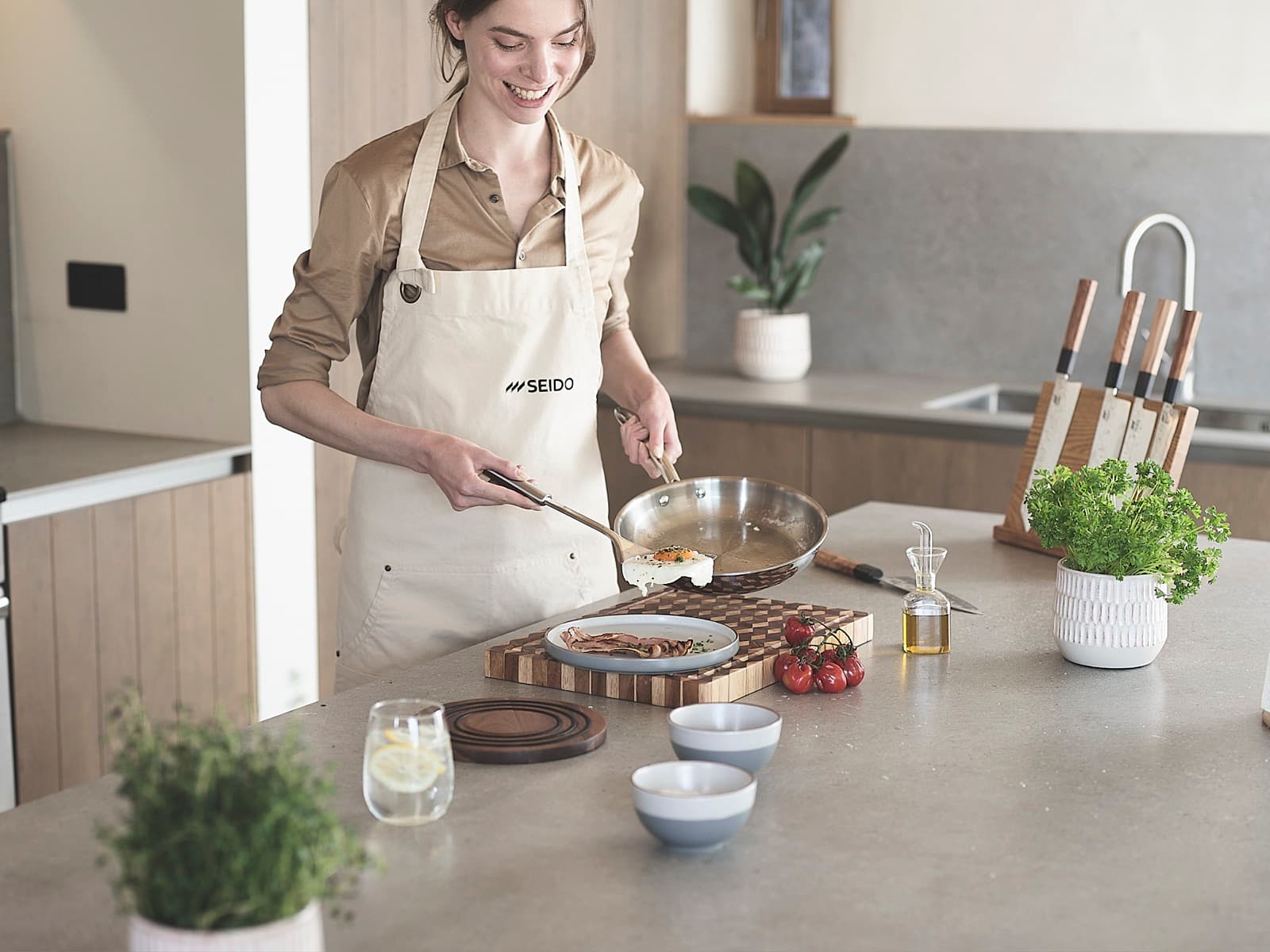
A hybrid pan sets a nonstick coating inside a raised stainless steel pattern, so it releases food more easily than bare steel but browns less fully. An uncoated stainless steel pan has no coating: food releases through heat, fat and timing, it builds fond for pan sauces, and there is no release layer to wear away.
What is a hybrid pan?
A hybrid pan is a coated pan with metal built into its cooking surface. As makers describe the category, a nonstick coating is applied to the pan, and a stainless steel pattern (often a lattice, grid or pattern of raised dots) is raised through or above it. Food touches both materials at once: the tops of the steel pattern and the coating sitting in the recesses between them.
The idea is to combine two behaviors. The coating supplies release, and the raised steel is meant to take the contact from utensils and add some browning where food meets metal. The coating chemistry varies by maker, so the product listing and care card are the places to find out what a given hybrid pan's coating is and how it should be treated.
An uncoated stainless steel skillet works on a different principle. The cooking surface is the steel itself, and there is no second material on it. Everything the pan does, it does through heat, fat and the cook's timing.
Are hybrid pans nonstick?
Partly. A hybrid pan releases food more easily than bare steel, because much of the surface is coating. It usually does not release as freely as a pan with a smooth, continuous nonstick coating, because the raised steel is bare metal and proteins can bond to it in the same way they bond to any stainless surface.
In practice that means a hybrid pan sits between the two familiar categories. Delicate foods such as eggs and flaky fish tend to need some fat and a properly heated pan, and many makers' own instructions say as much. How close a particular pan comes to full release depends on how much of its surface is steel and how much is coating, which differs from one design to another.
How does each pan cook: release versus browning and fond?
Browning needs contact and surface heat. The Maillard reaction, the set of reactions that turns a steak crust or an onion deep brown, runs quickly once the food's surface is dry and hot. Fond, the browned residue that clings to the pan after searing, forms when food makes firm contact with the metal and then releases as the crust sets.
On an uncoated stainless steel skillet, the whole surface can do this. Meat grips the pan at first, releases once the crust forms, and leaves fond behind. Pour in stock, wine or water, scrape, and that fond becomes the base of a pan sauce.
On a hybrid pan, browning happens mainly where food touches the raised steel, and the coating between the pattern is designed to resist the adhesion that fond depends on. You can still get color and a crust, but expect less fond to build up for deglazing. The trade runs the other way with eggs, pancakes and fish, where the coating makes release easier than it is on bare steel for most cooks.
How do you care for a hybrid pan compared with stainless steel?
Care follows the surface. An uncoated stainless steel skillet has fewer rules. Metal utensils will not damage a coating that is not there, stuck-on residue can be soaked and scrubbed away with a non-scratch scouring pad or a paste of baking soda and water, and a hard preheat for searing does not put a release layer at risk. The steel can still discolor with high heat; the rainbow-colored heat tint is cosmetic and usually wipes off with diluted white vinegar. Dishwasher and oven guidance is still set by each pan's maker, so check it rather than assume.
A hybrid pan carries a coating, so its maker's guidance is the rule to follow, and it differs between brands and coating types. Read it for three things before you cook:
- Utensils: whether metal tools are permitted, or whether the maker still recommends wood, silicone or nylon.
- Heat limits: the maximum stovetop setting and oven temperature, and whether the pan may be preheated empty.
- Cleaning: whether the pan is labeled dishwasher safe, and which scrubbers and cleaners the maker says to avoid on the coating.
How long does a hybrid pan last compared with stainless steel?
A coating is still a coating. The raised steel pattern on a hybrid pan is designed to take some of the wear from utensils and scrubbing, but the coating in between is exposed to heat, cleaning and use every time the pan is cooked in. As with any coated pan, release can fade over time, and cleaning or conditioning cannot rebuild a worn coating.
An uncoated stainless steel cooking surface has no release layer to lose. Its behavior on the first day and after years of use is set by the same thing: the cook's technique. Scratches and discoloration can change how the pan looks, but they do not remove a coating, because there is none.
Hybrid pan or stainless steel: which suits your cooking?
Think about the meals you actually cook on a weeknight, not the ones you cook once a year. Neither is a better pan in every kitchen: the choice comes down to what you cook most, how much technique you want to use, and whether you would rather manage a coating's care rules or a bare metal surface. A rough guide:
- A hybrid pan may suit you if you cook eggs, pancakes or fish most days, want easier release than bare steel gives, and are happy to follow a coating's heat and cleaning rules.
- An uncoated stainless steel skillet may suit you if you sear meat, brown vegetables and make pan sauces, want to preheat hard and scrub freely, and prefer a cooking surface with no coating to look after.
- Either works for everyday sautéing, as long as the pan is heated properly and there is enough fat in it. Plenty of kitchens keep both kinds of pan: something with a coating for eggs, and bare steel for searing and sauces.
Is there a third option besides hybrid and stainless steel?
Yes: cast iron and carbon steel. Both are uncoated metal pans that build seasoning, a thin layer of oil polymerized onto the surface by heat, which improves release with regular use. Both handle high heat well and brown food deeply.
They ask for a different kind of care. Both rust if they are left wet, so they are dried after washing and given a light film of oil. Long simmers of acidic foods such as tomato sauce can wear the seasoning and add a metallic taste. Cast iron is heavy and holds heat for a long time; carbon steel is thinner and lighter, and heats up and cools down faster.
What should you look for in an uncoated stainless steel skillet?
If bare steel fits the way you cook, check what the cooking surface is made of, whether a lid is included, and what the warranty covers. SEIDO's 9.5 in (24 cm) skillet is uncoated, with a 304 (18/8) stainless steel cooking surface. It is sold with a lid, is oven-safe with the lid off, and is backed by a 5-Year Limited Warranty. The 8 in (20 cm) and 11 in (28 cm) sizes share the same cooking surface.
Cooking this way is what our 9.5-inch stainless steel skillet is built for — 9.5 in (24 cm), tri-ply clad, oven-safe, 5-year limited warranty.
Frequently asked questions
- Is a hybrid pan the same as a stainless steel pan?
- No. A hybrid pan has a nonstick coating on its cooking surface with a raised stainless steel pattern set into it, so food touches both coating and steel. An uncoated stainless steel pan has no coating: the cooking surface is bare steel, and release comes from preheating, fat and timing.
- Can you use metal utensils on a hybrid pan?
- It depends on the maker. The raised steel pattern on a hybrid pan is designed to take contact from utensils, and some makers permit metal tools while others still recommend wood, silicone or nylon. Follow the care guidance for your specific pan, since the coating between the pattern is what utensils can wear.
- Do hybrid pans brown food as well as stainless steel?
- They brown food where it touches the raised steel, so you can get color and a crust. Because part of the surface is a coating designed to resist adhesion, a hybrid pan generally builds less fond than a fully uncoated stainless steel pan, which leaves less browned residue for deglazing into a pan sauce.
- Do eggs stick to stainless steel pans?
- They can, if the pan is too cool or too dry. Preheat an uncoated stainless steel skillet over medium heat until a few drops of water bead up and glide, add oil and let it shimmer (or butter and let it foam), then lower the heat slightly, add the eggs and give them time to set before moving them. That order gives eggs the best chance of releasing cleanly.
- Can a worn hybrid pan be restored?
- Not the coating. Cleaning can remove residue that makes any pan feel sticky, but once a nonstick coating has worn, cleaning or conditioning cannot rebuild the coating itself. The steel pattern itself does not wear in the same way, but the pan's release depends on the coating between it.
- Is carbon steel a hybrid pan?
- No. Carbon steel is an uncoated metal pan, like cast iron. It develops release through seasoning, a layer of oil polymerized onto the surface by heat, which builds with use and can be renewed. A hybrid pan relies on a factory-applied nonstick coating set within a stainless steel pattern.
Browse all stainless steel frying pans or keep reading: How to Cook Eggs on Stainless Steel Without Sticking · Why Food Sticks to Stainless Steel Pans · Stainless Steel vs Nonstick Pans.