How Hot Should a Stainless Steel Pan Be? Preheating, the Water-Drop Test, and Oils
Published September 17, 2026
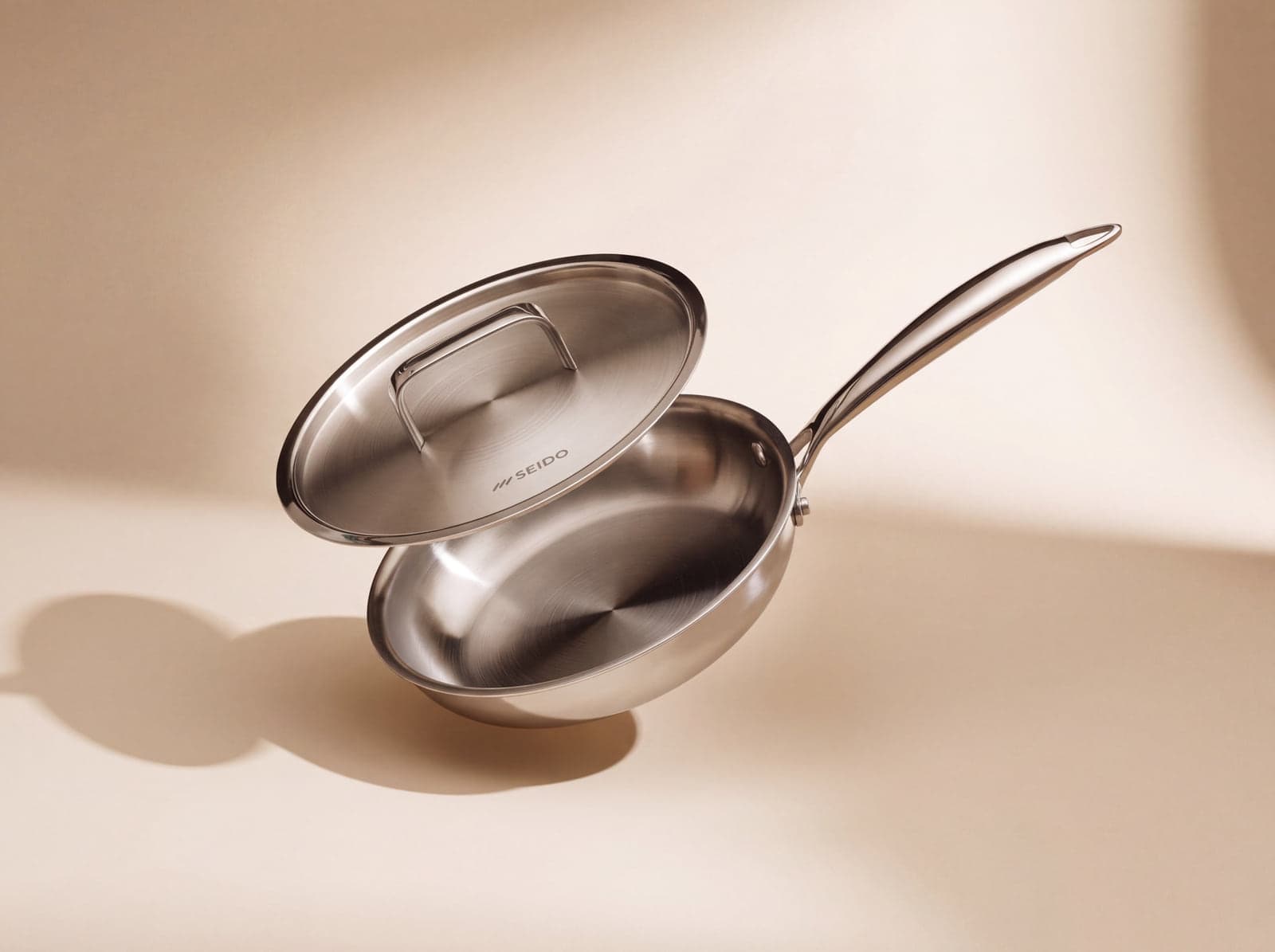
A stainless steel pan is hot enough when a few drops of water pull into beads that glide across the surface instead of sizzling away. Get there over medium heat: roughly two to three minutes on gas, three to five on electric, and one to two on induction. Then add oil, let it shimmer, and add the food.
How long should you preheat a stainless steel pan?
Preheat by result, not by clock. A timer gets you close, but the real signal is the water-drop test in the next section. As a starting point, put the dry, empty pan over medium heat and check it at these marks:
Pan size and build change those times. A larger or thicker pan takes longer to heat but holds its temperature better when cold food goes in. Clad construction, where an aluminum core is bonded between layers of steel (often sold as tri-ply), spreads heat across the base more evenly than steel alone.
Why medium and not high? High heat pushes an empty pan past the temperature you need before the heat has spread. Medium gets there evenly and leaves room to turn up for a sear.
- Gas: about 2 to 3 minutes. A flame responds the instant you turn it down, which makes an overshoot easy to correct.
- Electric coil or radiant glass cooktop: about 3 to 5 minutes. These elements warm up slowly and stay hot after you turn them down, so lift the pan off to cool it faster.
- Induction: about 1 to 2 minutes, sometimes less. Induction heats a compatible pan directly, so an empty pan on a high setting overshoots quickly.
What is the water-drop test for stainless steel pans?
The water-drop test reads the surface of the pan using the Leidenfrost effect. Flick a few drops of water onto the preheating pan and watch what they do.
The temperature where beading starts, the Leidenfrost point, shifts with the surface finish, how clean the pan is, and the size of the drop. That is why the test works better than a number: it measures your pan, on your stove, right now.
Once the beads glide, wipe away the water, add your fat, and wait until it shimmers. Shimmer comes before smoke. For eggs, turn the heat down a notch after the test; they want less heat than a sear.
- Not yet: the drops spread out, sizzle, and boil away within a few seconds. The pan is past water's boiling point of 212°F (100°C) but not hot enough to hold a drop off the metal.
- Ready: the drops pull into tight beads that glide around the pan like marbles. The underside of each drop turns to steam instantly, and the drop rides on that thin layer of vapor.
- Overshot: the oil smokes as soon as it touches the steel. Take the pan off the heat for a minute, then test again.
Why is my stainless steel pan smoking?
A smoking pan is usually telling you one of three things.
Clean stainless steel has nothing on it to burn. If a pan smokes before any fat goes in, the cause is almost always residue from the last cook.
- The oil is past its smoke point. Every fat starts to break down at some temperature, and visible smoke is the sign. The oil turns bitter and the smoke is harsh. Lower the heat, or switch to a fat with a higher smoke point.
- The butter is burning. Whole butter contains milk solids, and they brown and then burn at a lower temperature than most cooking oils. Add butter after you turn the heat down, or use clarified butter.
- Old residue is burning off. A thin film of oil or food left on the pan will smoke as the pan reheats. A thorough wash with hot, soapy water fixes it.
What oil is best for stainless steel pans?
The best oil is one whose smoke point sits comfortably above the heat you plan to cook at, with a taste you want in the dish. Published smoke points vary between sources and with how refined an oil is, so treat these as approximate ranges, not specifications:
For a hard sear, reach for a refined, neutral oil from the higher end of the list. For eggs and gentle sautéing over medium heat, butter or olive oil is plenty. Either way, a thin, even film that coats the base is enough.
- Whole butter: about 300 to 350°F (150 to 175°C). Best for gentle cooking and finishing.
- Extra virgin olive oil: about 320 to 410°F (160 to 210°C). Fine for everyday sautéing over medium heat.
- Refined canola oil: about 400 to 450°F (205 to 230°C). A neutral choice for most stovetop cooking.
- Refined peanut oil: about 450°F (230°C). Suited to stir-frying and shallow frying.
- Clarified butter or ghee: about 450 to 485°F (230 to 250°C). Butter flavor without the milk solids that burn.
- Refined avocado oil: about 500 to 520°F (260 to 270°C). Useful for searing at high heat.
Can you use cooking spray on stainless steel pans?
You can, but it tends to cause more trouble than it saves. On a hot pan, the parts of the thin spray film that food never covers can polymerize into a sticky, amber layer that hardens a little more with each use. It builds up fastest on the sides and around the rim, and soap and a sponge often will not shift it.
A simpler habit: pour in a little oil and spread it with a folded paper towel held in tongs. To remove existing build-up, scrub with a paste of baking soda and water, or a cleanser made for stainless steel.
Can you use metal utensils on stainless steel pans?
Yes. An uncoated stainless steel pan has no coating to scratch or flake, so a metal spatula, whisk, or pair of tongs is fine to use. A thin metal spatula is often the most useful tool on stainless, because its edge slides under a browned crust and lifts it in one piece.
Metal can still leave fine marks in the polished finish over time. Those marks are cosmetic. They are in the steel itself rather than in a coating, so there is nothing to peel or flake away. Do not cut food with a knife inside the pan: it marks the surface and dulls the knife.
How hot can a stainless steel pan get in the oven?
The steel is rarely the limit. What sets a pan's oven rating is everything attached to it: a nonstick coating, a plastic or wooden handle, or a lid with a knob, fittings, or a gasket. So the answer for any pan is the maker's rating for that specific pan, and the lid needs its own answer.
SEIDO skillets are oven-safe with the lid off. Take the lid off before the pan goes in.
Two practical notes for any pan. Treat a handle that has been in the oven as hot, and use a dry mitt or towel every time. And strong heat can leave golden or rainbow tints on stainless steel: a thin oxide layer whose thickness produces the colors, much like a film of oil on water. It is cosmetic, and our guide to cleaning a burnt stainless steel pan explains how to remove it.
What kind of skillet suits this way of cooking?
Everything above assumes bare steel: a pan you can preheat empty, test with water, and work with a metal spatula. SEIDO Sear Series skillets are made that way, with an uncoated 304 (18/8) stainless steel cooking surface, made without intentionally added PFAS and without synthetic coatings. They come in 8 in (20 cm), 9.5 in (24 cm), and 11 in (28 cm), each sold with a lid, oven-safe with the lid off, and backed by a 5-Year Limited Warranty.
Whichever pan you use, the routine is the same. Preheat over medium, test with water, add fat, then add food.
Cooking this way is what our 9.5-inch stainless steel skillet is built for — 9.5 in (24 cm), tri-ply clad, oven-safe, 5-year limited warranty.
Frequently asked questions
- What temperature should a stainless steel pan be for cooking?
- Hot enough that drops of water bead up and glide instead of sizzling away, which means well past water's boiling point of 212°F (100°C). Rather than chasing a number, use the water-drop test over medium heat, then adjust: turn the heat down for eggs, and keep it at medium to medium-high for searing.
- Should you add oil before or after preheating a stainless steel pan?
- After. Heat the dry pan first so you can run the water-drop test, which only works on a dry surface because water spatters in hot oil. Once the drops bead and glide, remove the water, add the oil, and wait for it to shimmer before the food goes in.
- Why does food still stick after I preheat the pan?
- Usually the pan lost heat when the food went in, or the food was moved too soon. Cold, wet food and an overcrowded pan both pull the surface temperature down. Pat food dry, cook in batches, and let seared food release on its own before you turn it.
- Is it bad to heat an empty stainless steel pan?
- Not over medium heat, which is exactly how the water-drop test works. The problem is an empty pan left on high heat, especially on induction, where it can get far hotter than cooking needs. That can leave heat tint on the steel and makes the first splash of oil smoke right away.
- Do metal utensils ruin stainless steel pans?
- No. Uncoated stainless steel has no coating to scratch or flake. Metal tools can leave fine cosmetic marks in the polished finish over time, but those marks are in the steel itself, so there is nothing to peel away. Avoid cutting food with a knife inside the pan.
Browse all stainless steel frying pans or keep reading: How to Cook Eggs on Stainless Steel Without Sticking · Why Food Sticks to Stainless Steel Pans · Stainless Steel vs Nonstick Pans.