Ceramic Nonstick vs Stainless Steel Cookware: What Actually Differs
Published September 17, 2026
A ceramic nonstick pan is a metal pan, usually aluminum, with a thin silica-based coating that helps food release with little fat. A stainless steel pan has no coating: food release comes from preheating and fat. Ceramic is easier on day one; bare stainless steel has no surface layer to wear away.
What is a ceramic nonstick coating, exactly?
Despite the name, a ceramic-coated pan is not a ceramic pan. It is a metal body, most often aluminum and sometimes stainless steel, with a thin coating applied to the cooking surface. That coating is typically made by a sol-gel process: a liquid built from silicon-based compounds is sprayed onto the pan and cured with heat into a hard, glass-like layer of silica.
On its own, a silica surface is hard but not especially slippery. To get food to release, coating makers commonly blend in a small amount of silicone oil, which sits at and near the surface and acts as the release agent. That detail matters later, because it explains how the coating behaves over months of use.
It is also worth knowing what a sol-gel coating is not. It is not PTFE, the fluoropolymer used in conventional nonstick coatings, and it is not the same thing as enameled cookware, where glass is fused onto cast iron or steel at high temperature.
How do ceramic-coated and stainless steel pans cook differently?
The biggest difference is how food leaves the surface. On a fresh ceramic coating, an egg slides with a thin film of butter and almost no technique. On stainless steel, the same egg needs a preheated pan and enough fat, or its proteins bond to the metal.
That bonding is not all bad. Stainless steel lets meat, fish and vegetables grip the pan, brown hard and then release once a crust forms. The browned bits left behind, called fond, are what you deglaze with stock or wine to make a pan sauce. A coating is designed to prevent that contact, so ceramic-coated pans build less fond.
Heat behavior differs too. Most ceramic-coated pans are aluminum, which heats quickly and evenly but is usually cooked on lower settings to protect the coating. Stainless steel handles steady medium-high heat for searing and can go from stovetop to oven with a sauce still in the pan, within the maker's guidance.
- Ceramic coating suits: eggs, omelets, pancakes, delicate fish, reheating, low-fat cooking.
- Stainless steel suits: searing, browning, pan sauces, sautéing, shallow frying, stovetop-to-oven dishes.
Why does ceramic nonstick lose its release over time?
Many owners notice that a ceramic-coated pan releases food less easily after months of regular use. Laboratory studies published in 2024 (Journal of Food Engineering) and 2025 (Results in Engineering) found that sol-gel ceramic coatings released food less well than PTFE coatings, and in the 2025 study the force needed to release food from the ceramic coatings rose over repeated cooking cycles. Coating makers describe why: the silicone oil that gives the release is not bonded to the silica beneath it and is gradually used up.
The factors usually named are high heat, abrasive cleaning and metal utensils. Many makers also advise against aerosol cooking sprays, which can leave a sticky film on the surface. How fast the release fades varies with the coating, the pan and how it is used, so treat any single figure you see with caution.
Stainless steel does not work this way. With no coating on the cooking surface, there is no release layer to deplete. How the pan behaves in year five depends on the same things it depended on in week one: heat, fat and timing.
How are cookware coatings regulated in the US?
In the United States, materials that touch food, including cookware coatings, are subject to the Food and Drug Administration's food-contact regulations. The practical guidance for a coated pan is about use: stay within the maker's heat recommendations, never heat an empty pan on high, and follow the maker's advice on when a scratched, chipped or worn coating should be replaced.
For stainless steel, the food-safety question is simpler because the surface is the metal itself. The 304 grade, also called 18/8 for its roughly 18% chromium and 8% nickel, is a common food-grade stainless steel used for cookware, sinks and food-processing equipment.
How hot can you cook in ceramic nonstick versus stainless steel?
There is no single number for either material, so the maker's printed guidance for your specific pan is the one to follow. Handles, lids and knobs often set the limit before the cooking surface does.
Ceramic-coated pans commonly come with advice to cook on low to medium heat, use a little oil or butter rather than none, and avoid overheating the pan while empty. High heat is also one of the factors linked to faster loss of release.
Uncoated stainless steel tolerates higher stovetop heat without a coating to protect, which is why it is the usual choice for searing. It still has limits. Overheating an empty pan can scorch oil into a sticky film and leave a rainbow heat tint, and for handles and lids, check the maker's guidance.
How do you clean and care for each type of pan?
Ceramic-coated pans last longer with gentle handling. Stainless steel can take firmer cleaning. Let either pan cool before it meets cold water, because a sudden temperature shock can warp thin metal.
- Ceramic coating: wash by hand with a soft sponge and mild dish soap; use wooden, silicone or nylon utensils; skip aerosol cooking sprays; stack with a cloth or pan protector between pans.
- Stainless steel: stuck-on food lifts after a short soak in warm water, or simmer a little water in the pan and scrape with a wooden spoon.
- Stainless steel stains: a paste of baking soda and water or an oxalic-acid cleanser removes browned residue; a splash of white vinegar clears rainbow heat tint and white mineral spots.
- Both: check the maker's guidance before putting either in a dishwasher or oven.
Which one suits the way you cook, and is there a third option?
Choose ceramic-coated if most of your cooking is eggs, pancakes and delicate fish, you want easy release with minimal technique, and you are comfortable replacing the pan when the coating wears. Choose stainless steel if you sear, brown and make pan sauces, want a surface with no coating whose release wears away, and are willing to learn to preheat properly.
There are other categories worth knowing. Hybrid pans set a nonstick coating inside a raised stainless steel pattern, aiming for some release plus some browning, though the coating is still a coating. Cast iron and carbon steel are uncoated metals that build a seasoned surface through use and need drying and oiling to prevent rust. Enameled cast iron suits braises and stews more than quick frying.
A common setup is a small coated pan reserved for eggs and a stainless steel skillet for everything else. That way the coated pan only does the job it does well, at the gentle heat that job needs.
Where does an uncoated SEIDO skillet fit?
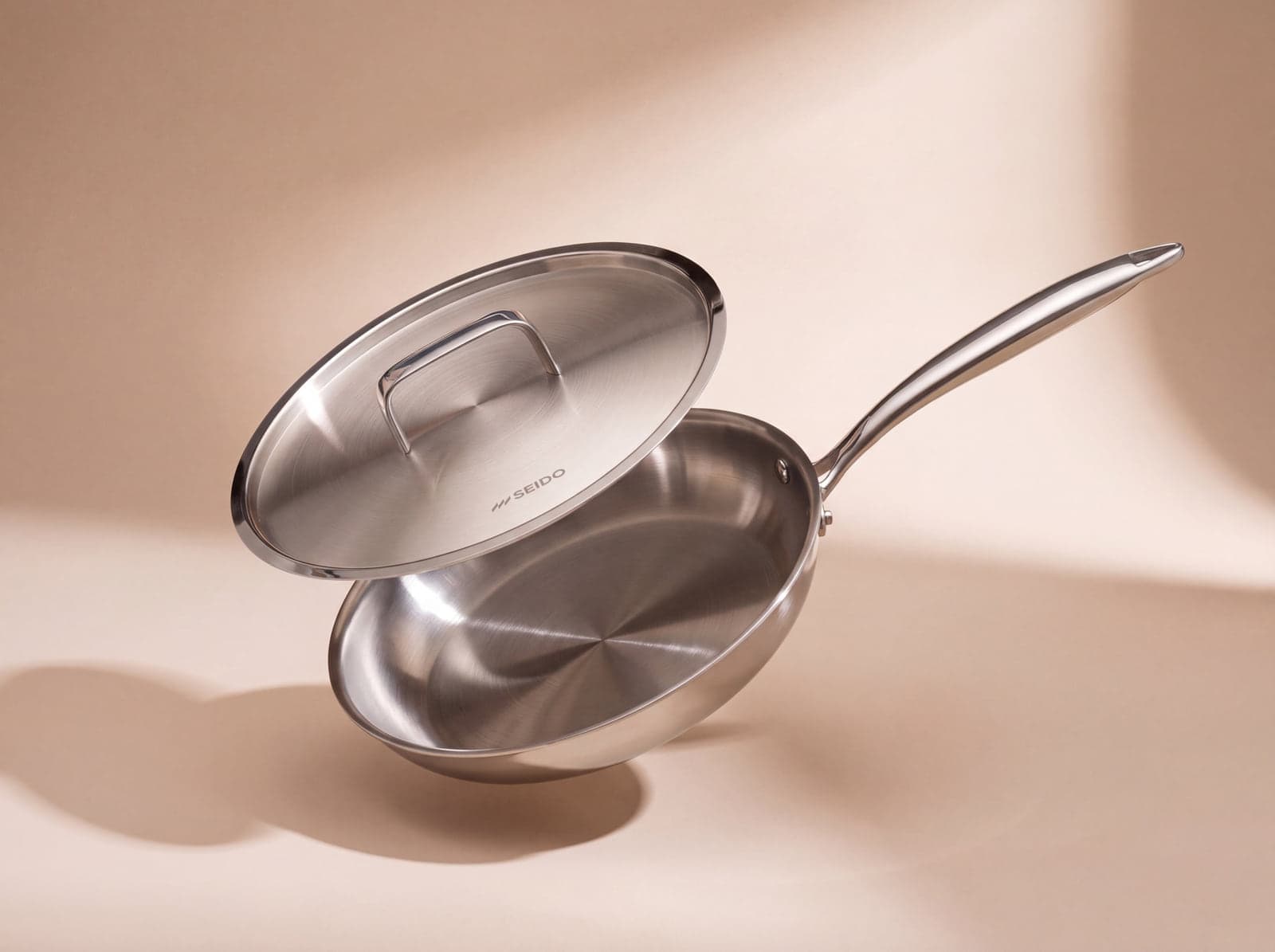
If the stainless steel side of this comparison describes your cooking, the SEIDO 9.5 in (24 cm) skillet is one uncoated option. It has a 304 (18/8) stainless steel cooking surface and is uncoated, so there is no release layer to wear away. It is sold with a lid, is oven-safe with the lid off, and carries a 5-Year Limited Warranty. It is also available in 8 in (20 cm) and 11 in (28 cm). See price on Amazon.
Cooking this way is what our 9.5-inch stainless steel skillet is built for — 9.5 in (24 cm), tri-ply clad, oven-safe, 5-year limited warranty.
Frequently asked questions
- Is ceramic cookware the same as ceramic-coated cookware?
- Usually not. Most pans sold as ceramic nonstick are metal pans, often aluminum, with a thin silica-based coating applied by a sol-gel process. Solid ceramic or stoneware cookware is a different product, and enameled cast iron, which has glass fused onto iron, is different again.
- Why is food starting to stick to my ceramic pan?
- Ceramic coatings commonly rely on a small amount of silicone oil at the surface for release, and coating makers describe that oil being gradually used up over repeated cooking and cleaning. High heat, abrasive scrubbing and metal utensils are the factors usually named. Many makers also advise against aerosol cooking sprays, which can leave a sticky film.
- Does food stick more to stainless steel than to ceramic nonstick?
- On a cold or dry pan, yes. On a stainless steel pan preheated until a drop of water beads and glides, with a thin layer of fat added before the food, most foods release once they have browned. Eggs and delicate fish take the most practice.
- Can you use metal utensils on ceramic nonstick or stainless steel?
- Makers of ceramic-coated pans generally recommend wooden, silicone or nylon utensils to protect the coating. Uncoated stainless steel has no coating to scratch through, so metal spatulas and whisks are common, although they can leave fine surface marks that do not change how the pan cooks.
- Which lasts longer, ceramic nonstick or stainless steel?
- An uncoated stainless steel pan has no coating whose release can wear out, so it does not lose release the way a coating does. A ceramic-coated pan's release tends to decline with use, at a rate that depends on the coating, heat and care, and many owners replace it when food starts to stick.
- Do you need to season a stainless steel pan?
- No. Stainless steel is smooth and dense, so oil does not build up a lasting seasoned layer the way it does on cast iron or carbon steel. The reliable method is a clean pan, a proper preheat, enough fat and dry food.
Browse all stainless steel frying pans or keep reading: How to Cook Eggs on Stainless Steel Without Sticking · Why Food Sticks to Stainless Steel Pans · Stainless Steel vs Nonstick Pans.