Are Nonstick Pans Safe? What PTFE, Scratches and Heat Actually Do
Published September 17, 2026
Nonstick pans coated with PTFE are authorized by the FDA for food contact and are considered safe when used as directed. The risks are overheating and a worn coating: PTFE starts to break down above about 500°F (260°C). Use low to medium heat, and replace a pan once its coating flakes.
What is a nonstick coating made of?
Most traditional nonstick pans are coated with polytetrafluoroethylene, or PTFE. Teflon is the best-known trade name for it. PTFE is a long chain of carbon atoms fully wrapped in fluorine atoms, and the carbon-fluorine bond is one of the strongest in chemistry.
That structure is what makes the coating slick. Very little sticks to a surface made of tightly held fluorine, so eggs and fish slide with almost no fat. The same stability means PTFE does not react with food at normal cooking temperatures.
For decades a related chemical, PFOA, was used as a processing aid when PTFE was manufactured. US manufacturers phased PFOA out under an EPA stewardship program that ended in 2015. A label that mentions PFOA is describing that change; the coating on the pan is usually still PTFE.
PTFE is itself a fluoropolymer, which broad definitions count as a PFAS, and several US states now regulate intentionally added PFAS in cookware. That wider question is why some cooks choose uncoated pans instead.
What happens when a nonstick pan overheats?
PTFE is stable in normal use, but it has a ceiling. Above roughly 500°F (260°C) the coating begins to degrade, and at higher temperatures it breaks down faster and gives off fumes. Coating manufacturers publish their own maximum temperatures for this reason, and most advise low to medium heat.
Breathing heavy fumes from badly overheated PTFE can cause polymer fume fever, a temporary flu-like illness described in the medical literature. Pet birds are far more sensitive, which is why manufacturers warn bird owners specifically.
The usual route to overheating is an empty pan on high heat. Without food or liquid to absorb energy, a thin pan's surface temperature climbs quickly. At low to medium heat, food and liquid in the pan generally keep the surface well below the range where PTFE degrades.
Practical rules follow from the chemistry:
- Never preheat a nonstick pan empty on high heat.
- Cook on low to medium heat, and follow the maker's stated maximum.
- Turn on the range hood or open a window when cooking.
- Keep nonstick pans away from the broiler unless the maker says otherwise.
- Keep pet birds out of the kitchen while cooking with coated pans.
Is it safe to use a scratched nonstick pan?
A light surface scratch is mostly a performance problem. The coating around it still releases food, although food starts to catch along the damaged line.
Deeper damage is different. Once the coating is peeling or flaking, pieces can come away into food, and the exposed base metal underneath was never meant to be a cooking surface. Most manufacturers say to stop using a pan at that point.
Scratches also tend to spread. Food catches, the cook scrapes harder, and the damage grows. Wooden, silicone, or nylon utensils slow that cycle, and so does hand washing with a soft sponge instead of an abrasive pad.
When should you throw away a nonstick pan?
A nonstick coating is a wear layer, so every coated pan has a working life. Heat, utensils, abrasive cleaning, and the dishwasher all shorten it. Replace the pan when you see any of these signs:
- The coating is flaking, peeling, or blistering.
- Bare metal shows through in patches.
- Food sticks across the whole surface even with fat added.
- The surface is deeply discolored or warped from overheating.
Is ceramic nonstick different from PTFE?
Yes, in chemistry. "Ceramic" nonstick is usually a sol-gel coating: a silica-based film applied as a liquid and cured into a thin, glassy layer. It is made without fluoropolymers, so it is not PTFE.
It is still a coating, and it still wears. Sol-gel surfaces get their release from a very smooth finish, and many cooks find that release fades sooner than on PTFE, especially with high heat, sprays, or abrasive cleaning. The same replacement signs apply: once it chips or food sticks everywhere, the coating has reached the end of its life.
The word "ceramic" on a label describes the coating type. It does not tell you about the base metal, the maker's heat limit, or how long the finish will last, so read the maker's own care guidance.
Why are PFAS rules changing for cookware?
PFAS is a large family of fluorinated chemicals prized for resisting heat, water, and grease. Many are persistent, meaning they break down very slowly in the environment. Broad definitions, including the OECD's, include fluoropolymers such as PTFE in that family.
Some US states have acted on cookware. Minnesota restricted the sale of cookware with intentionally added PFAS from 2025, and California requires cookware makers to disclose intentionally added PFAS. These laws focus on how PFAS are made, used, and disposed of across their whole life cycle, not only on what happens in one kitchen.
For a shopper, the result is more labels. Read them closely: a label about PFOA and a label saying "made without intentionally added PFAS" describe different things.
What changes when you switch to uncoated stainless steel?
An uncoated stainless steel pan has no wear layer: the cooking surface is the metal itself, so there is no coating to flake. It tolerates higher stovetop heat than a coated pan and can be scrubbed firmly, for example with a nonabrasive powder cleanser or a baking soda paste.
The trade-off is technique. Bare steel does not release food on its own. It needs a properly preheated pan, a thin layer of fat, and patience before the first flip. Eggs are the steepest part of the learning curve, and our guides to why food sticks to stainless steel and to cooking eggs in stainless cover the method step by step.
Many kitchens keep both: stainless for searing, sautéing, and sauces, and a coated pan for delicate eggs cooked gently. Choosing is less about one right answer and more about how you cook and how carefully you look after a coating.
Where do SEIDO skillets fit?
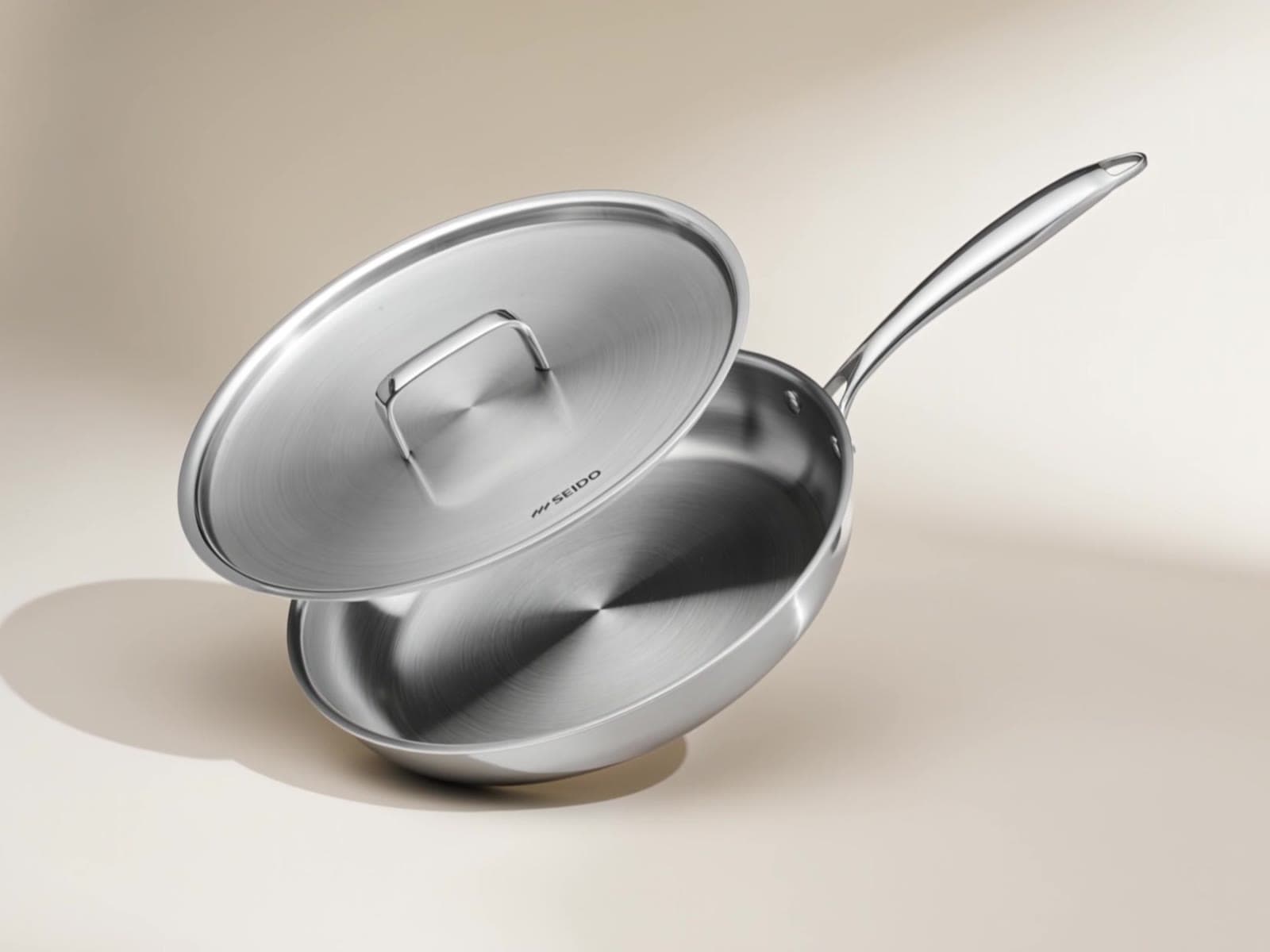
SEIDO skillets are uncoated, with a cooking surface of 304 (18/8) stainless steel, made without intentionally added PFAS and without synthetic coatings. They come in 8 in (20 cm), 9.5 in (24 cm), and 11 in (28 cm), each sold with a lid, and each is backed by a 5-Year Limited Warranty. If you are replacing a worn nonstick pan, the 9.5 in (24 cm) is a practical everyday size. See price on Amazon.
Cooking this way is what our 9.5-inch stainless steel skillet is built for — 9.5 in (24 cm), tri-ply clad, oven-safe, 5-year limited warranty.
Frequently asked questions
- Are nonstick pans safe to cook with?
- PTFE nonstick pans are authorized by the FDA for food contact and are considered safe when used as directed. Cook on low to medium heat, never preheat the pan empty, and stop using it once the coating flakes or peels.
- Is Teflon toxic?
- Teflon is a trade name for PTFE, a very stable plastic that does not react with food at normal cooking temperatures. It degrades above about 500°F (260°C) and can release fumes, which is why makers advise moderate heat and good ventilation.
- Is it safe to use a scratched nonstick pan?
- A light scratch mainly affects performance, because food starts to catch along it. If the coating is flaking, peeling, or showing bare metal, most manufacturers advise replacing the pan.
- When should I throw away a nonstick pan?
- Replace it when the coating flakes, peels, or blisters, when bare metal shows through, when food sticks across the whole surface, or when the pan is warped or deeply discolored from overheating.
- Is ceramic nonstick a PTFE coating?
- No. Ceramic nonstick is usually a silica-based sol-gel coating made without fluoropolymers. It is still a coating that wears, and many cooks find its release fades sooner than PTFE's.
- What is the healthiest cookware to use?
- No single material is right for every cook. Stainless steel, cast iron, and carbon steel are uncoated; PTFE and ceramic pans are coated and wear over time. Choose by how you cook, and follow the maker's heat and care guidance.
Browse all stainless steel frying pans or keep reading: How to Cook Eggs on Stainless Steel Without Sticking · Why Food Sticks to Stainless Steel Pans · Stainless Steel vs Nonstick Pans.